
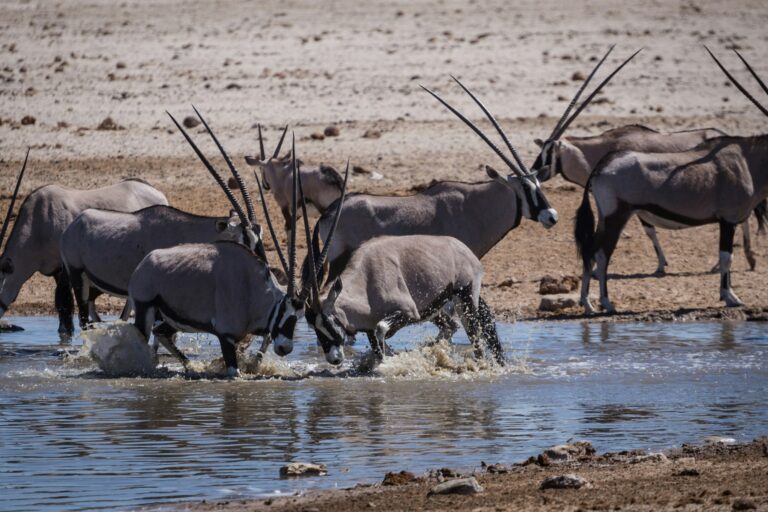
Gemsbokvlakte Waterhole is an open-plains stop in the Okaukuejo area where the landscape is as important as the water. The low vegetation and broad horizon support long-distance scanning, environmental portraits and patient observation of animals approaching across exposed ground.
The name does not promise gemsbok, and a waterhole never follows a visitor timetable. Season, recent rain, water availability, temperature, predators, road activity and chance all influence what appears. Treat Gemsbokvlakte as one stop within a compact loop rather than a guaranteed wildlife stage.
This guide explains how to plan Gemsbokvlakte Waterhole around current roads, where to look when the water itself seems quiet, how to photograph the open setting and when to move on. It also notes the road-upgrade detours affecting the Okaukuejo–Halali corridor in 2026, which must be checked again for your dates.
Place Gemsbokvlakte Waterhole in the Okaukuejo route
Gemsbokvlakte lies in the wider Okaukuejo sector and can fit a short local circuit or a longer eastbound transfer when the current road network permits. Always use the map and directions issued for the travel date. Road construction, grading, rain and management closures can change the route or make a familiar loop unsuitable.
From an Okaukuejo base, the useful question is whether Gemsbokvlakte Waterhole supports the day’s return margin. A dedicated local drive can combine it with one or two nearby open-country stops. A transfer towards Halali should treat every waterhole as optional because check-in, detours and slower roads take priority.
| Plan | How Gemsbokvlakte may fit | Main caution |
|---|---|---|
| Short morning from Okaukuejo | One primary stop plus a nearby fallback | Do not race to a distant second loop |
| Late-afternoon local drive | Open light and a simple return to camp | Work backwards from the current return time |
| Okaukuejo-to-Halali transfer | A stop on the authorised current route | Construction or detours can add time |
| Photography session | Repeat the same view under different light | Do not occupy excessive space |
| Family drive | A compact stop with broad visibility | Heat and long waiting may limit attention |
Use a primary stop and a fallback
Choose Gemsbokvlakte Waterhole as the primary only when its position fits the loop. Mark one nearby alternative and a return point. If the waterhole is crowded, the road is rough or the driver’s concentration falls, use the fallback without treating the change as a failed safari.
The site’s guide to Etosha’s best waterholes explains how to compare open-plain, woodland-edge and camp waterholes. It avoids ranking them as if wildlife were guaranteed.
A Gemsbokvlakte Waterhole viewing method
1. Scan before moving into position
Slow down on approach and check where other vehicles are parked, whether animals are using the road and whether dust will drift across the viewing area. Do not stop suddenly or block through traffic. If the legal viewing position is full, continue rather than creating a second row that traps others.
2. Look beyond the water
At Gemsbokvlakte Waterhole, begin with the open ground between the vehicle and horizon. Animals may approach slowly, pause at a distance or use the surrounding grass without drinking. Scan in bands from near to far with binoculars, then recheck dark shapes, movement and the base of isolated shrubs.
3. Let the scene settle
Park, switch off the engine when safe and considerate, and lower voices. A newly arrived vehicle can change animal behaviour. Give the stop ten to twenty quiet minutes before deciding it is empty, but leave sooner if crowding, heat or the route deadline makes waiting unwise.
4. Watch approach and exit routes
Do not place the vehicle between wildlife and the water or close the gap another animal is using. A clear line matters more than a closer photograph. If animals hesitate, bunch tightly, turn away repeatedly or focus on vehicles, increase space or leave.
5. Record conditions, not only species
Note time, temperature, wind, cloud, recent rain and the waterhole’s apparent condition. Those observations help explain why a later visit differs. A species list without context encourages false rules about the “best” hour.
Season and time at Gemsbokvlakte Waterhole
During drier periods, dependable water can attract wildlife, but Gemsbokvlakte Waterhole may still be quiet for long stretches. After rain, animals can use temporary water and fresh grazing across a wider area. Open vegetation helps scanning, yet higher grass after useful rain can hide smaller species.
Morning
Cooler air can reduce heat shimmer and make distant photography easier. Animals may be feeding or moving away from water rather than arriving to drink. Low light creates long shadows, so expose for the subject and watch the bright ground.
Midday
Heat can increase water demand, but it also challenges travellers and cameras. Use shade and air flow responsibly, drink water and avoid a long session when children or the driver are uncomfortable. Midday light can produce graphic high-contrast images of the plain.
Late afternoon
Warm side light can reveal dust and shape, while the return deadline becomes the controlling factor. Decide the departure time before wildlife arrives. If an active sighting continues at that time, leave calmly; Gemsbokvlakte Waterhole never justifies a late return.
Use the late dry season guide for heat and dust planning and the rainy-season guide for flexible roads and dispersed wildlife.
Photograph Gemsbokvlakte Waterhole as a landscape
The open setting rewards wider compositions. A close animal portrait can be made at many waterholes; a frame that shows the subject’s scale against Gemsbokvlakte’s pale ground and long horizon tells a more specific story. Begin wide, then move to a tighter lens only when the animal remains comfortable.
Stability from the vehicle
- Use a beanbag or folded support on the window frame.
- Switch off the engine when safe and when it does not disrupt traffic.
- Keep the lens inside the vehicle’s outline where required.
- Set a shutter speed that accounts for subject movement and wind.
- Review highlights on pale ground without staring at the screen during activity.
Our Etosha car-window photography guide explains support, shutter speed and composition in more detail. Prepare settings before Gemsbokvlakte Waterhole becomes active so the vehicle remains quiet.
Use negative space deliberately
Place a gemsbok, springbok or bird against the open plain with room in its direction of movement. A small subject can communicate scale. Avoid centring every animal at the water’s edge; tracks, dust, reflections and distant silhouettes can carry the image.
Control heat shimmer
Long lenses compress a large volume of warm air, making a distant subject look soft. Photograph earlier, wait for the animal to approach naturally or use shimmer as atmosphere. Do not drive closer to solve an optical problem.
Keep colour honest
Pale ground can push automatic white balance and exposure in different directions. Use a neutral reference when practical, protect highlights and keep some natural warmth or dust. Heavy contrast and saturation can erase the subtle open-plains character.
Gemsbokvlakte Waterhole etiquette
- Remain inside the vehicle except at designated places.
- Park only where legal and leave a route for through traffic.
- Do not call, whistle, imitate or feed wildlife.
- Keep voices, music and repeated door movements low.
- Never block an animal’s line to or from water.
- Use lenses and binoculars instead of closing the distance.
- Leave when congestion creates unsafe or stressful behaviour.
Etiquette matters especially on an open plain because animals and other vehicles can see and hear an approach from far away. Raise as little dust as possible and settle before activity reaches the water.
How long should you wait?
There is no correct duration. Twenty quiet minutes may reveal an approach; an hour may remain empty. Base the decision on temperature, passenger comfort, road conditions and the remaining loop. Patient observation is valuable only while the overall plan remains safe.
Check the current Gemsbokvlakte road situation
Road upgrades between Okaukuejo and Halali are changing access in 2026. Official notices have directed traffic along specific deviations, including routes via Gemsbokvlakte. The arrangement is temporary and may change as phases progress.
Before departure, read the latest park notice and ask the gate or camp for the day’s route. The Ministry traffic-deviation notice for the Gemsbokvlakte road explains the official change, while later notices may supersede it. Never rely on an old screenshot once signs or staff give newer instructions.
- Allow extra transfer time and reduce the planned waterhole count.
- Expect construction traffic, dust and temporary speed restrictions.
- Stay out of closed works areas and remain in the vehicle.
- Do not use an unauthorised track because it appears shorter on a map.
- Recalculate the Halali or Okaukuejo return margin after every delay.
A repeat-visit plan for Gemsbokvlakte Waterhole
If the route and road notices allow, two short sessions can teach more than one long vigil. Visit Gemsbokvlakte Waterhole in cooler morning light, record the wind and visible water, then return on another day or later session without assuming the same animals will appear.
First visit: learn the shape of the place
Use a wider lens or binoculars to identify the horizon, approach lines, legal parking and the direction of light. Spend less time reviewing photographs and more time learning where vehicles and animals move. Even a quiet first Gemsbokvlakte Waterhole stop makes the second visit easier.
Second visit: change one variable
Return at a different time of day, after a weather change or with a guide. Keep the route similar so the comparison remains useful. A different species list is not the only result: dust, grass colour, cloud, tracks and traffic can all show how Gemsbokvlakte Waterhole changes.
Know when repetition becomes pressure
Do not circle the viewing area repeatedly, follow an animal or compete for the same space. If Gemsbokvlakte Waterhole is congested, choose the fallback and return another day. Repetition should produce patient observation, not repeated disturbance.
Use a simple field note
Write the date, arrival and departure times, weather, road condition, visible wildlife and one behaviour. Avoid publishing sensitive live locations for vulnerable animals. The note helps the family remember the experience and prevents a single exceptional Gemsbokvlakte Waterhole visit from becoming a false promise to future travellers.
Nine Gemsbokvlakte Waterhole decisions before you stop
- Does the waterhole fit the authorised current route?
- How much time remains before the camp or gate deadline?
- Can the vehicle park without blocking others?
- Where are animals approaching from?
- Is dust blowing towards wildlife or viewers?
- Are passengers comfortable enough to wait quietly?
- Which lens or binoculars are ready before arrival?
- What shorter fallback protects the return?
- When will the vehicle leave even if activity begins?
Common Gemsbokvlakte Waterhole questions
Will I see gemsbok?
Possibly, but the name is not a guarantee. Oryx, other plains wildlife, birds and predators use the wider landscape according to conditions. Enjoy whatever appears and avoid publishing a fixed species schedule.
Is Gemsbokvlakte Waterhole close to Okaukuejo?
It is part of the Okaukuejo-area network, but current detours and road conditions determine the useful driving time. Use the latest official map and staff guidance rather than a historic kilometre estimate.
Is morning or afternoon better?
Neither is universally better. Morning often reduces heat shimmer; afternoon can bring warmer light and increasing time pressure. Wildlife activity varies with season, water and chance. Choose the session that fits a short legal loop.
Can I photograph from outside the vehicle?
No, not at an ordinary roadside waterhole. Remain inside unless you are at a clearly designated place where getting out is permitted. A photograph never justifies breaking park rules.