
Etosha vultures are easiest to understand when you look up before you look at the ground. A circling group can reveal rising warm air, a communal search pattern or interest in activity below, but it does not automatically mean there is a fresh carcass. Watch the whole scene and let behaviour guide the identification.
White-backed and lappet-faced vultures are among the species visitors may encounter in Etosha National Park. White-headed and hooded vultures may also occur, while other regional species are less predictable. Identification depends on age, light and distance, so record uncertainty instead of forcing every bird into a name.
This guide explains how to distinguish likely Etosha vultures, read soaring and feeding behaviour, position a vehicle without pressuring birds and photograph responsibly. It is a field method rather than a sightings promise: season, food, wind, nesting activity and chance shape every day.
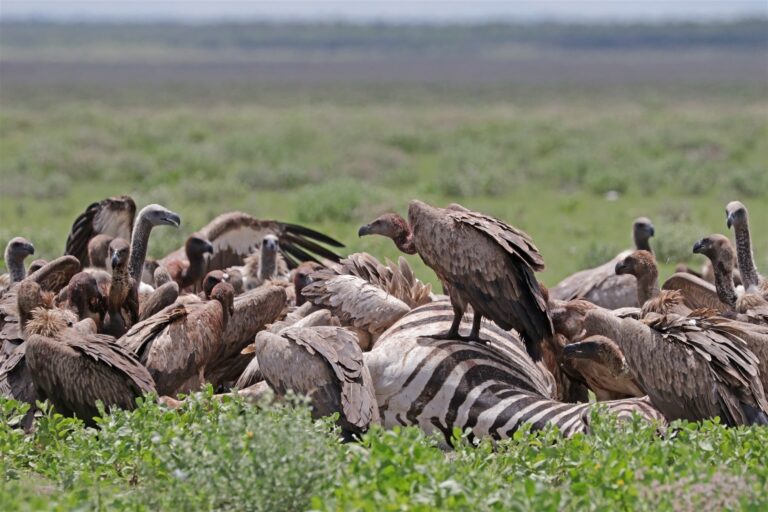
Identify Etosha vultures by structure, not one colour
Begin with size, wing shape, tail length and flight style. Plumage varies between juveniles and adults, and a pale back can disappear in harsh light. A field guide or birding app helps, but the strongest record combines a photograph with notes on structure and behaviour.
| Possible species | Useful field clues | Common identification trap |
|---|---|---|
| White-backed vulture | Broad wings, short dark tail, pale back most obvious on adults | Juveniles are browner and the pale back may be hidden |
| Lappet-faced vulture | Very large build, broad wings, strong bill and bare reddish head | Head colour and facial folds are difficult at long range |
| White-headed vulture | Contrasting head and body pattern, relatively compact appearance | Strong sunlight can wash out the pattern |
| Hooded vulture | Smaller, slimmer silhouette with a narrow-looking head | Distance can make size comparison unreliable |
White-backed vulture
White-backed vultures often gather in groups and can dominate the first impression at a carcass. In flight, look for broad wings with fingered primaries and a short tail. On a settled adult, the pale back contrasts with darker wings; younger birds can look more uniformly brown.
Do not identify Etosha vultures solely because several birds are feeding together. Mixed groups occur, and size is easiest to judge only when birds stand on the same ground. Check the head, bill, back and stance before making a confident record.
Lappet-faced vulture
The lappet-faced vulture is a powerful, heavy-looking bird with a strong bill. Adults have an obvious bare reddish head at close range, but heat shimmer can hide that colour. At a feeding site it may open tough hide or displace smaller scavengers, giving it an important role within the group.
A large bird does not need to be placed at the top of a simple “pecking order.” Access changes with the carcass, number of birds, arrival time and individual behaviour. Watch several interactions instead of turning one displacement into a fixed rule.
White-headed and hooded vultures
White-headed vultures show a distinctive contrasting head pattern when the view is good. Hooded vultures are smaller and finer built. Both can be missed when attention stays on a large cluster of white-backed birds, so scan the edges, nearby trees and late arrivals.
Unusual Etosha vultures deserve cautious notes. Photograph the upperwing, underwing, tail and head when possible, then compare the record with a current southern African field guide. “Vulture species” is a better field note than an unsupported rare identification.
How Etosha vultures use rising air
Large vultures reduce the energy cost of searching by using thermals—columns of rising warm air—and other uplift. They circle to gain height, then glide across country while losing altitude slowly. The next useful column lets them climb again without continuous flapping.
Why morning skies may look empty
Cool early air produces weaker thermals. Etosha vultures may remain on roosts or use low, effortful flight until the ground warms. A quiet dawn therefore does not mean the birds have left the area. Scan prominent trees and return to the sky as heating develops.
What a “kettle” tells you
A group circling in the same rising air is often called a kettle. Birds can join because they see others gaining height, creating an efficient information network. A kettle indicates useful lift; it is not proof that every bird has found food.
Separate searching from descending
- Wide, steady circles that gain height usually indicate lift.
- A long glide away from the group may be routine searching.
- Repeated low passes and a controlled descent deserve closer observation.
- Birds gathering in trees may be resting, waiting or assessing safety.
- Rapid flight away from the ground may indicate disturbance.
Follow Etosha vultures with binoculars rather than chasing them by vehicle. Roads seldom lead directly beneath a bird, and leaving the authorised route is prohibited. Let the sky add information to the planned loop; do not let it pull the driver into unsafe decisions.
Where and when to watch Etosha vultures
Open plains make large silhouettes easier to see, while tall trees can provide roosting and nesting structure. Waterholes may attract vultures to drink or bathe, but a waterhole is not the only place to search. Scan above woodland edges, broad plains and any legal roadside view with good sky.
Use light and wind
Mid-morning heating often improves soaring activity. Wind can create additional lift but also makes perched photography harder. Photograph with the sun behind or to the side when possible, then check the underwing pattern as a bird turns. Do not park facing traffic simply to improve the light.
Look without predicting a carcass
A cluster of stationary vehicles, scavenging birds or predator activity can indicate a feeding site, but approach slowly and remain prepared to continue. Never drive onto a verge, block traffic or follow another vehicle off route. The absence of a carcass is not a reason to search restricted ground.
The Etosha safari guide helps match sectors, daily loops and accommodation. Birders can also use the Etosha birdwatching guide to balance waterholes, woodland and open-country stops.
Responsible viewing when Etosha vultures are feeding
A carcass is a working wildlife site, not a vehicle arena. Scavengers must balance hunger with safety, and repeated engine noise, doors, voices or close repositioning can keep birds waiting. Stop at a lawful distance, switch off the engine when safe and let the birds choose whether to approach.
Keep a clear escape route
Do not surround the feeding area or close gaps between parked vehicles. Birds need open ground for take-off, particularly large species carrying a full crop. If Etosha vultures repeatedly run, hop away, hold wings open toward vehicles or abandon the carcass, increase distance.
Stay inside the vehicle
Remain inside except at a designated place where exit is expressly allowed. A carcass may attract predators and other scavengers, and the birds themselves need space. Never move a carcass, bone, feather or piece of vegetation to improve a photograph.
Do not publish urgent location details
Sharing a general sighting later is different from broadcasting a live carcass or vulnerable nesting location. Avoid real-time coordinates, never disclose a nest site and follow current park or guide guidance. Responsible records protect birds and reduce sudden traffic at sensitive places.
| Behaviour observed | Possible meaning | Best visitor response |
|---|---|---|
| Birds remain settled or feed normally | Current distance may be tolerated | Stay quiet and avoid repositioning |
| Heads repeatedly turn toward vehicles | Birds are assessing disturbance | Reduce noise and movement |
| Birds walk or fly away from the site | Pressure may be too high | Increase distance or leave |
| Birds descend only after vehicles depart | Viewing position disrupted access | Do not return immediately |
| Several vehicles block the road | Traffic and wildlife risk are increasing | Continue to the next legal stop |
Photograph Etosha vultures from inside the vehicle
Prepare before the action. Set a useful shutter speed, autofocus mode and exposure compensation while the vehicle is still. A beanbag or folded support on the window steadies a long lens. Keep equipment within the vehicle outline and never open a door for a lower angle.
For soaring birds
- Use continuous autofocus with an expandable focus area.
- Begin with a shutter speed that freezes wing and head movement.
- Leave space in the frame for the bird to fly into.
- Expose for the underwing when the sky is bright.
- Take short bursts and pause to keep watching behaviour.
A wide field of view helps you find a circling bird; zoom in only after tracking is stable. If autofocus hunts against a blank sky, pre-focus on a distant tree or switch to a smaller focus area. Etosha vultures often bank repeatedly, offering a better view without the vehicle moving.
For feeding groups
Start with a wider frame that shows the ecological context and the spacing between species. Then isolate one behaviour: a landing posture, raised wings, a bill interaction or a bird waiting at the edge. Avoid a sequence made only of graphic close-ups; a responsible story can show the scavengers’ function without sensationalising the carcass.
Control heat shimmer and dust
Long focal lengths magnify hot moving air. If a distant bird looks soft, wait for a closer natural approach, use a wider environmental image or return under cooler conditions. Driving closer is not a photographic solution. Protect equipment from dust and change lenses only when the cabin is calm.
Our car-window photography guide covers stable support and quiet composition. The same approach lets passengers observe Etosha vultures without constant door movement.
Why responsible Etosha vulture viewing matters
Vultures remove carrion efficiently and form an essential part of functioning ecosystems. Many African vulture populations have declined severely. Poisoning is a major threat, including deliberate poisoning and unintended exposure at poisoned carcasses; collision, electrocution, disturbance and habitat pressures also matter.
BirdLife International’s vulture overview explains the scale of African declines and the central role of poisoning. Visitors should not investigate a suspicious carcass themselves. Record the location from a safe distance and report unusual numbers of dead or incapacitated birds to park staff immediately.
What a traveller can do
- Observe from legal roads and designated areas only.
- Report suspected poisoning or injured birds without touching them.
- Avoid playback, baiting, feeding and nest disturbance.
- Choose guides and operators that follow park rules.
- Keep real-time nest and carcass locations private.
- Credit licensed photographs accurately.
- Treat every uncertain identification honestly.
Report, do not rescue
A weak bird may be poisoned, injured or simply heat-stressed. Handling can expose people and wildlife to danger and can destroy evidence. Stay in the vehicle, note the nearest road or waterhole, photograph the scene from a distance if safe and contact the nearest camp, gate or ranger.
Nine checks for an Etosha vultures sighting
- Am I identifying structure as well as colour?
- Is the bird an adult or a darker juvenile?
- Is the group climbing in a thermal or descending?
- Can I stop without blocking the road?
- Do the birds have a clear approach and take-off route?
- Is my engine, voice or door movement changing behaviour?
- Can I make the image without moving closer?
- Should the location remain private?
- Does anything unusual need to be reported to staff?
Common questions about Etosha vultures
Does circling mean there is a dead animal below?
Not necessarily. Etosha vultures circle in thermals to gain height and can watch other birds while searching a wide area. A coordinated low descent is more informative than a high kettle, but visitors should never leave the road to investigate.
Which vulture is most common in Etosha?
White-backed vultures are frequently encountered and may gather in numbers, but sightings vary. Do not use one trip to declare a permanent ranking. Record what you see and compare it with a current regional guide.
Can I get out to photograph a feeding group?
No, not at an ordinary roadside sighting. Stay inside the vehicle unless the site is clearly designated for exit. Open doors, low angles and a closer image are never worth breaking park rules or disrupting feeding.
What should I do if several vultures appear dead?
Do not touch the birds or carcass. Keep people away, record the location and report it immediately to park staff or the nearest camp or gate. A rapid professional response may protect other scavengers and preserve evidence.