
Etosha shoulder season is the transition between the greener, wetter part of the year and the established dry season—or the reverse transition when heat builds and the first rains may arrive. It can offer changing landscapes, useful availability and a less rigid safari rhythm, but it is not a fixed set of dates or a guarantee of mild weather and empty roads.
For planning, think of two different shoulder experiences. The late-wet to early-dry transition, often around April to June, may retain green colour while mornings become cooler. The late-dry to early-rain transition, often around October and November, can combine concentrated waterhole activity with heat, dust and uncertain first storms.
The best Etosha shoulder season for you depends on which trade-off is acceptable: cool layers or high heat, greener cover or open visibility, dispersed wildlife or busy waterholes, flexible road plans or peak-demand booking pressure. Rainfall and temperature vary by year, so check current conditions shortly before travel.
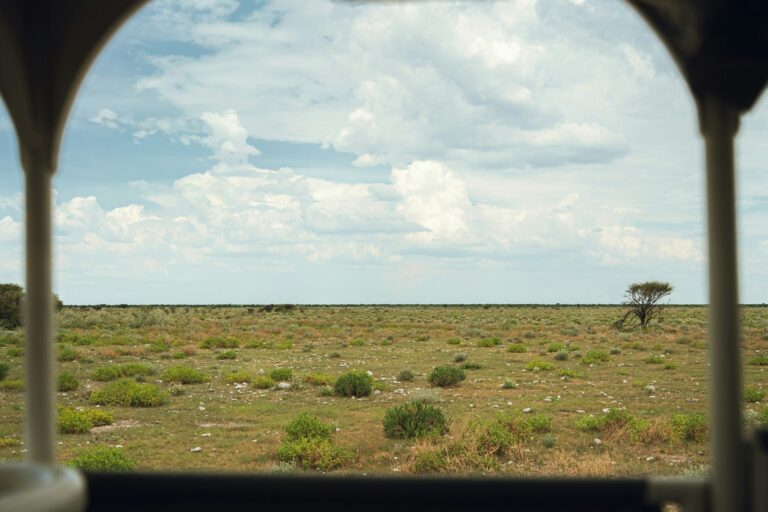
Etosha shoulder season means two different transitions
| Transition | Possible character | Main planning risk |
|---|---|---|
| Late wet to early dry | Residual green growth, changing bird activity, cooler nights developing | Assuming every road has dried or wildlife already concentrates at waterholes |
| Early to mid dry | Comfortable days, progressively thinner vegetation, cold dawns | Underpacking warm layers or expecting late-dry waterhole patterns |
| Late dry to first rains | Open views, water dependence, dramatic heat or storm build-up | Heat, dust, crowds and a first storm changing roads quickly |
| Early green transition | Fresh growth, clouds and more temporary water | Wildlife dispersal and highly local rainfall |
These labels describe patterns, not boundaries. A strong rain event can change one sector while another remains dry. A late start to the rains can keep November harsh and dusty; an early end can make May feel drier than expected. Use the calendar to choose a starting expectation, then replace it with current observations.
April to June: cooling and drying
This Etosha shoulder season often appeals to travellers who want fewer extremes. Vegetation may still carry colour after useful rain, road surfaces may be improving, and the coldest winter mornings may not yet have arrived. Wildlife can use a wider range of grazing and water, so patient habitat scanning matters more than a sprint between famous waterholes.
By June, dawn can be properly cold, particularly in an open guided vehicle. Pack layers, gloves or a warm hat according to the forecast and remove them as the day warms. A green background does not mean the road is wet, and a dry-looking road does not prove every side loop is open.
October to November: heat and uncertainty
The later Etosha shoulder season is more demanding. Waterhole viewing may still resemble the late dry season while temperatures rise and dust intensifies. The first meaningful rain may arrive, or it may not. A storm can create dramatic light and temporary water while also making a planned road unsuitable.
Choose this period only if the group tolerates heat and can shorten the midday driving block. Air-conditioning helps on transfers but does not make a hot parked vehicle safe. Carry drinking water, protect children and older travellers, and never leave anyone waiting in a closed car.
Set realistic Etosha shoulder season wildlife expectations
Wildlife responds to water, grazing, temperature, disturbance and movement across a large landscape. During a drying transition, animals may gradually rely more on dependable water, but the concentration is not immediate or uniform. After rain, fresh grazing and temporary pools can draw wildlife away from the stops that were productive yesterday.
An Etosha shoulder season safari therefore rewards observation across habitats. Scan open plains, woodland edges and the road ahead. Watch tracks and animal posture without turning them into promises. If a famous waterhole is quiet, let the current conditions change the route rather than calling the day unsuccessful.
Birding changes with the transition
Seasonal migrants and breeding behaviour can make the greener Etosha shoulder season attractive to birders, while dry conditions concentrate activity around remaining water. Exact timing varies. Use an up-to-date regional checklist and avoid playback that disrupts feeding, nesting or territorial behaviour.
The official Ministry page for Etosha National Park describes the park’s habitats and wildlife diversity. It is a useful reminder that Etosha is more than a waterhole circuit, especially when seasonal change spreads animals across the landscape.
Photography gains variety, not certainty
- Residual green colour can separate animals from pale ground.
- Clouds soften contrast and create changing shafts of light.
- Late-dry dust can add atmosphere but reduce sharpness and visibility.
- Fresh rain may produce reflections, while heat creates shimmer.
- One short repeat route can show the same habitat under very different light.
Weather and roads during Etosha shoulder season
Rain in northern Namibia is seasonal but highly variable. The Ministry’s Etosha fire-management strategy describes a broad October-to-April rainfall season and significant variation across the park. That range is a management context, not a traveller’s daily forecast. Use a current reputable forecast, then ask staff about roads each morning.
Never drive around an Etosha shoulder season closure, onto a soft shoulder or into water of uncertain depth. A dry start does not guarantee a dry return, and another vehicle crossing safely does not prove the surface will support yours. Park rules and local instructions override a saved map or social-media report.
Pack for both ends of the day
A useful Etosha shoulder season day bag contains a warm or wind-resistant layer, sun protection, drinking water, a compact rain layer when relevant, camera protection and a dry pouch for documents. The exact combination changes between the two transitions; do not use an April packing list unchanged in November.
Protect the return margin
Choose a main loop and a shorter alternative. When rain builds, heat affects the driver or a road is rougher than expected, use the shorter route before the deadline becomes a problem. The final waterhole is always optional; the current gate or camp return time is not.
Our guide to the best time to visit Etosha National Park compares the full dry and green seasons. The Etosha month-by-month guide then adds a calendar framework without promising exact conditions.
Balance Etosha shoulder season crowds and availability
Shoulder dates may feel quieter than the most popular dry-season weeks, but national holidays, school breaks, events and limited room categories can still create demand. “Shoulder season” also does not guarantee a lower rate. Each property sets its own seasons, inclusions and cancellation terms.
Compare the final value: room type, meals, child policy, game drives, gate distance and cancellation flexibility. A slightly higher rate close to the right gate can reduce fuel, transfer time and fatigue. A cheaper stay far from the planned sector may cost the safari its best observation hours.
Use flexibility without gambling the whole trip
Flexible cancellation can be useful when road or weather uncertainty matters, but waiting too long can remove suitable family rooms, campsites or automatic vehicles. Reserve the route essentials first and leave flexibility in daily loops and optional activities rather than in every bed.
| Traveller priority | Useful shoulder choice | Important caution |
|---|---|---|
| Cooler driving and some green scenery | Late wet to early dry transition | Cold dawns and dispersed wildlife remain possible |
| Open views and waterhole activity | Late dry transition | Heat, dust and visitor pressure may be high |
| Birding and storm photography | Early green transition | Rainfall and access are uncertain |
| Lower visitor pressure | Non-holiday transition dates | Quiet is never guaranteed at famous stops |
| Flexible rates or availability | Compare exact property dates | Shoulder labels differ between businesses |
Build a flexible Etosha shoulder season day
Morning: start close to the base
Use nearby habitat before committing to a long route. Check road information at reception or the gate, carry the correct layers and let temperature decide how long the first stop lasts. Animals may be moving away from water in cool conditions, so scan between named waterholes.
Midday: treat comfort as a wildlife strategy
Heat can rise sharply in the later transition. Return to camp, use shade or choose a short observation stop where legal. A rested driver sees more and makes better decisions than one forcing a full-day loop because the calendar says “shoulder.”
Afternoon: use a short primary loop
Recheck clouds, wind and the return time. Pick one priority habitat or waterhole and one fallback. If a storm, crowd or road condition reduces the value, turn back early and use a camp waterhole or accommodation activity where available.
A guided drive can be particularly useful in Etosha shoulder season because local staff can interpret recent rain, tracks, fire history and current animal movement. It remains a nature experience rather than a guarantee, and travellers should choose the departure that fits temperature and family routine.
Give a changing season enough nights
A one-night Etosha shoulder season stay leaves little room for a storm, a quiet waterhole or a delayed transfer. Three nights across one or two neighbouring bases often create a more forgiving rhythm: a short arrival drive, one full day and a final morning. The exact number should fit the wider Namibia route, but do not remove all flexibility simply because accommodation looks available.
Extra time also lets the Etosha shoulder season reveal change. A road can look dry one morning and carry fresh puddles the next; animals can shift from a permanent waterhole to new grazing. Repeating a compact area helps you notice that movement without crossing the park at speed.
Nine Etosha shoulder season planning trade-offs
- Green colour may mean wildlife is more dispersed.
- Open vegetation may come with dust and strong heat.
- Quieter dates may have reduced activity schedules at some properties.
- Flexible rates may come with restrictive cancellation conditions.
- Cold dawns can lead to comfortable afternoons.
- Dramatic clouds can also close a route.
- A famous waterhole may be quieter after rain.
- Last-minute booking can improve choice in one category and remove it in another.
- A shorter stay saves money but gives less room for changing conditions.
None of these is automatically negative. The Etosha shoulder season is valuable because the safari is visibly changing. Choose the transition whose uncertainty interests you, then give the itinerary enough time to absorb it.
How to decide whether Etosha shoulder season fits you
- Choose your preferred transition: cooling and drying, or heating and first rain.
- Rank wildlife concentration, birding, scenery, comfort and crowds.
- Check school-holiday and local-demand dates rather than assuming quiet.
- Reserve the correct vehicle and park sector.
- Pack for the actual forecast and cold-or-heat tolerance of the group.
- Build one weather-proof fallback into every driving day.
- Reconfirm roads, times and services close to travel.
Common Etosha shoulder season questions
Which months are Etosha shoulder season?
There is no official fixed definition. Travellers commonly use the term for transitions around April to June and October to November, but conditions do not switch on calendar dates. Check the year’s rainfall, temperature and booking demand.
Will there be fewer vehicles?
Possibly, outside holidays and popular dry-season weeks, but no date guarantees an empty waterhole. Limited access points can concentrate visitors even when overall occupancy is lower. Arrive calmly, park legally and leave when congestion affects wildlife or safety.
Is wildlife viewing worse?
It is different rather than automatically worse. Drying conditions may increase water dependence; fresh rain may disperse wildlife and encourage habitat-based searching. Longer observation and a guide can help visitors enjoy the change instead of chasing a fixed list.
Should I book fewer nights because rates may be lower?
Use the same route logic as any season. Extra time is valuable when weather and wildlife distribution are changing. Compare the total price and inclusions, then preserve enough nights to avoid cross-park rushing.