
Staying outside Etosha for more accommodation choice can be the right decision when an inside rest camp is full, your group needs a family room, or you want a lodge experience with more facilities. The trade-off is access: every safari day must begin at a gate and finish before you are required to leave the park.
When staying outside Etosha, the useful question is not simply “inside or outside?” It is “outside which gate, for which part of the park, and with how much driving?” A well-chosen lodge a short distance from the correct gate can support an excellent itinerary. A beautiful property on the wrong side of Etosha can turn every morning into a transfer.
Use this guide to compare gate areas, calculate the real daily rhythm and decide when an outside stay gives you more value than an inside booking.
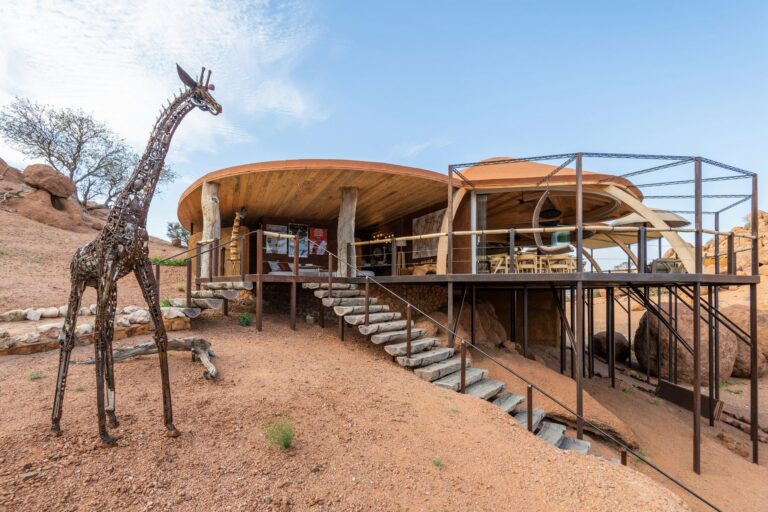
Why staying outside Etosha creates more choice
Accommodation beyond the park boundary ranges from simple guest farms and campsites to full-service safari lodges. That broader supply can make it easier to find interleading rooms, private bathrooms, a pool, a particular meal plan or a level of service that suits a celebration. It may also give a group more flexibility when the official rest camps have limited availability.
Outside accommodation is not automatically cheaper or more luxurious. Prices, inclusions and standards vary widely. Compare the whole stay: meals, guided activities, transfer arrangements, cancellation terms and the distance to the gate. If a low room rate adds two long return drives and extra fuel, it may not be the bargain it first appears.
Staying outside Etosha can also work well at the beginning or end of a visit. You can arrive from elsewhere in Namibia, settle without racing a park closing time, and enter the next morning after a proper rest. The same logic applies on departure when an extra night outside breaks the onward journey.
For many travellers, staying outside Etosha for more accommodation choice is therefore less about luxury and more about finding the room type, meal plan and arrival pattern that the group can use comfortably.
The practical benefit of staying outside Etosha for more accommodation choice should always be measured against the time required to reach and leave the park each day.
Choose the gate before the lodge
Etosha is too large to treat every entrance as interchangeable. If you are staying outside Etosha, start with the wildlife areas and onward route you want, then look for accommodation near the gate that serves them. Always check current gate and tourist-road times for your travel dates; do not build a plan around an old timetable.
| Gateway area | Best suited to | Planning caution |
|---|---|---|
| Andersson Gate and the southern approach | Okaukuejo, central-western waterholes and arrivals through Outjo | A property described as “near Etosha” may still be a substantial drive from the gate. |
| Von Lindequist Gate in the east | Namutoni, Fisher’s Pan and travellers approaching through Tsumeb | Allow time for entry formalities before beginning the day’s wildlife loop. |
| King Nehale Gate in the north | Northern approaches and a route linked to the Namutoni side | Confirm the property’s exact access route and seasonal road information. |
| Galton Gate in the west | A remote western itinerary with suitable bookings and current access | Distances are large and services are fewer; this is not the default gate for a short first visit. |
For the southern sector, compare Outjo accommodation with options closer to Andersson Gate. In the east, see the Namutoni-area accommodation and the route notes in two nights near Von Lindequist Gate. If the wider trip is still taking shape, the Namibia Travel Guide destination overview helps place Etosha within a longer national itinerary.
Inside and outside Etosha stays compared
| Decision factor | Inside the park | Outside the park |
|---|---|---|
| Start and finish of the safari day | No daily gate entry, but camp and tourist-road rules still apply | Daily entry and exit through a gate are required. |
| Accommodation choice | Limited to the official in-park camps and their available room types | Wider range of lodges, guest farms, campsites and room configurations. |
| Floodlit waterholes | Some camps provide after-hours viewing for resident guests | No access to in-park camp waterholes after leaving the park. |
| Facilities and atmosphere | Practical park-base experience | Can offer more lodge services, space or guided activities. |
| Route flexibility | Strong when moving between Etosha sectors | Strong when using one gate repeatedly or connecting to an onward route. |
Neither column is universally better. A mixed plan is often the most useful answer: one or two nights inside for early route access and a floodlit waterhole, followed by an outside lodge for extra space or a slower finish. The right split depends on availability and on whether changing accommodation improves the geography enough to justify another check-in.
Staying outside Etosha for more accommodation choice is strongest when that extra choice does not create an inconvenient daily commute.
Build a realistic day when staying outside Etosha
Staying outside Etosha does not remove the need for a daily buffer. At breakfast, departure and park entry can all take longer than expected. In the afternoon, a good sighting may occur when you need to begin the return journey. Plan backwards from the official exit requirement and turn towards the gate before the schedule becomes tight.
When staying outside Etosha for more accommodation choice, treat the access drive as part of every safari day rather than a once-off transfer.
A practical outside-stay rhythm
- Prepare water, cameras and documents the evening before so departure is quiet and quick.
- Leave the lodge with enough time to reach the gate without speeding on access roads.
- Choose a compact morning loop instead of crossing several Etosha sectors in one day.
- Use the hotter middle of the day for a shaded waterhole, a rest stop where permitted, or an unhurried lunch.
- Set a firm turn-around time based on the distance back to your exit gate.
- Keep a margin for wildlife, road conditions and the exit process.
The official Namibia Wildlife Resorts website is a useful starting point for current information about the state-operated camps, while park notices and staff instructions on the day take priority over any online guide.
Who benefits most from an outside stay?
Families and larger groups
Families may value flexible room layouts, space between game drives and meal arrangements that suit children. The gain disappears if the lodge is so far from the gate that every child spends the best wildlife hours in transit. Check drive time using the actual entrance, not the edge of the national-park label on a map.
This is where staying outside Etosha for more accommodation choice can work especially well: the family gains a suitable room without abandoning a sensible gate-area plan.
Travellers who prefer a guided safari
Some outside lodges arrange guided drives into Etosha. When staying outside Etosha, ask whether the activity enters the national park, how many guests share the vehicle, what the quoted duration includes and whether park fees are separate. A guided drive can reduce navigation pressure, but it should never be advertised as a guarantee of a particular animal.
Road trippers linking Etosha with the rest of Namibia
Staying outside Etosha can connect neatly with Otjiwarongo and the southern approach, the eastern route through Tsumeb, or a western journey towards Kamanjab. It is particularly useful when the next destination lies beyond the gate you already plan to use.
Travellers focused on maximum park time
If the priority is the earliest practical start, the latest practical finish and access to an in-camp waterhole, an inside booking may still be the stronger choice. See the guide to Etosha floodlit waterholes before paying more for an outside lodge whose facilities you will barely use.
Booking checklist for staying outside Etosha for more accommodation choice
- Confirm the exact gate and the realistic one-way drive time.
- Check whether meals, park fees, transfers or game drives are included.
- Ask about late check-in if the property is used after a long road day.
- Verify family-room capacity instead of assuming an extra bed can be added.
- Read the cancellation terms and keep the confirmation available offline.
- Confirm current park times close to departure and again on arrival.
- Make sure the next day’s route uses the same side of Etosha.
Staying outside Etosha for more accommodation choice works when the accommodation and the safari route solve the same problem. Choose the gate first, protect time for entry and exit, and value honest logistics more than a vague promise of being close to the park.
Related planning guides
- On the way to Etosha — choose the most useful approach and stopover.
- Okaukuejo or Namutoni — compare the western and eastern sectors.
- Self-drive Etosha — plan vehicles, roads and realistic daily distances.