
Flamingos on the Etosha Pan are possible when rainfall and shallow-water conditions align, but they are not a dependable date on a calendar. Water may be patchy, brief or far from a public viewpoint, and birds can move as feeding and breeding conditions change.
Plan a wet-season birding experience rather than a single-species promise. The same pans and flooded grasslands can reward patient observers with waders, pelicans, storks, ducks and raptors even when flamingos remain distant or absent.
Flamingos on the Etosha Pan need the right conditions
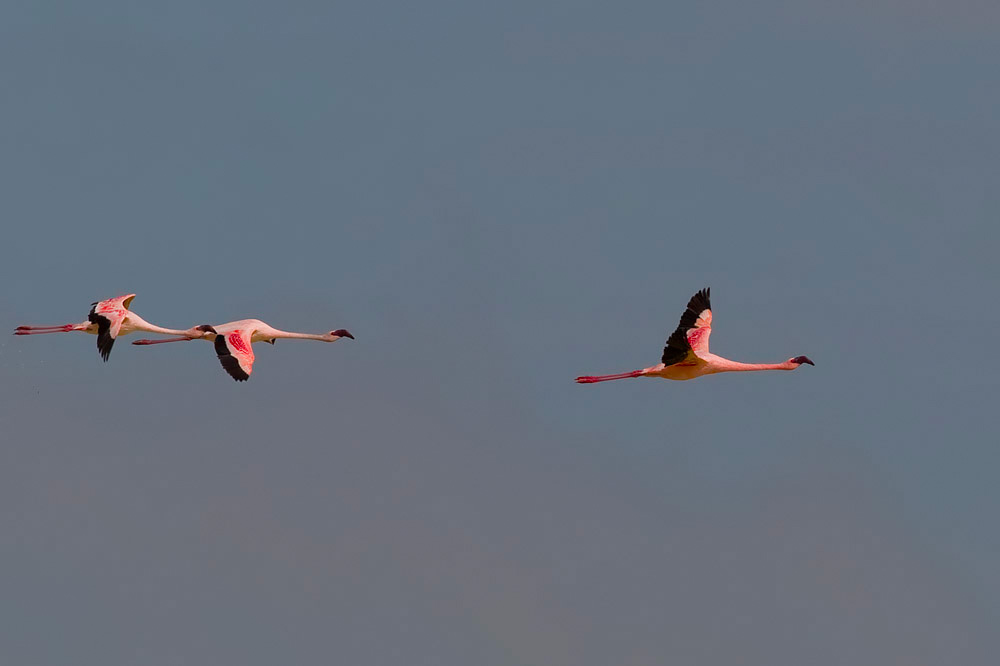
The official Ramsar listing describes Etosha Pan and the connected Cuvelai drainage as an ephemeral wetland system that can serve as a flamingo breeding ground in good rainy seasons. “Good” is the important word; conditions vary widely.
Suitable shallow water, food and enough time before evaporation all matter. Local rain near a lodge does not prove that the wider system has received the inflow needed to support large numbers.
Set expectations before the trip
| Expectation | More realistic view |
|---|---|
| The pan fills every summer | Water extent differs by year and location |
| Flamingos stand beside the road | Birds may be very distant |
| One rainstorm creates breeding | The wider hydrology and food supply matter |
| A guide can guarantee them | A guide can interpret conditions, not command wildlife |
Ask about recent conditions, but treat every report as time-sensitive. A photograph posted days earlier may describe a different water level and a different position.
Identify distant flamingos carefully
Greater and lesser flamingos can be difficult to separate at long range. Compare overall size, bill colour and structure only when distance and light allow it. Heat shimmer can distort legs, necks and flock edges.
- Use binoculars before the camera.
- Support a spotting scope securely.
- Record uncertainty in the species list.
- Avoid extreme crops presented as diagnostic evidence.
Keep breeding and feeding birds undisturbed
Remain on legal roads and viewpoints. Do not walk onto the pan, bypass barriers or use playback to pull birds closer. A flock repeatedly lifting, changing direction or abandoning a feeding area needs more distance.
Share broad habitat descriptions rather than live nesting coordinates. Sensitive bird colonies can attract pressure long after one visitor has left.
Build a broader wet-season bird plan
- Check recent rainfall and road information.
- Include temporary pans and flooded grassland.
- Carry a southern African field guide.
- Allow time for distant scanning.
- Value the complete bird community.
Read the Etosha rainy-season guide and keep alternative habitats in the route. Flexibility is more useful than a fixed flamingo chase.
Use photography to document habitat
Make wide frames that show water extent, pan edge and flock scale before attempting close crops. Record heat shimmer and distance as limitations. The Etosha birdwatching guide develops the field method, while seasonal pans and temporary wetlands explain why the scene may change quickly.
Flamingos on the Etosha Pan: check conditions before expectations
Seeing flamingos on the Etosha Pan depends on water, food, access and movement across a vast landscape. A photograph from a previous season is not proof of current conditions. Ask staff what has been observed recently, then treat any report as a clue rather than a guarantee.
Use this habitat checklist
- Water: is there broad shallow water, isolated pools or only reflective salt?
- Food: do distant feeding lines or other waterbirds suggest productive shallows?
- Wind: can heat shimmer, dust or glare make pale birds difficult to identify?
- Distance: are binoculars or a spotting scope needed for a responsible view?
- Access: is the observation point on a legal public road or designated lookout?
When searching for flamingos on the Etosha Pan, scan in bands from the near edge to the horizon. Large groups can resemble a pale line in glare, while single birds may disappear against salt. Confirm size, bill shape and feeding posture before recording a species.
Plan an alternative wildlife day
If there are no flamingos on the Etosha Pan, the outing has not failed. Look for other wetland birds where water remains, observe grassland species on the approach roads or visit permanent waterholes. This flexible plan protects travellers from racing between distant viewpoints.
Never leave the road, drive onto the pan or approach a flock for a closer image. Use a long lens for context and avoid sharing precise live locations. Conditions suitable for flamingos on the Etosha Pan may be brief and local, so honest notes should include the date, water and viewing distance. The most useful report of flamingos on the Etosha Pan explains the conditions and uncertainty instead of promising that future visitors will see the same scene.
flamingos on the Etosha Pan: practical questions
Which month guarantees flamingos?
No month guarantees them; rainfall, water depth and food conditions vary.
Can flamingos be seen from normal roads?
Sometimes, but they may be distant or beyond useful public viewpoints.
Is the main pan the only place to look?
No. Temporary pans and connected wetlands can also support bird activity.
Flamingos on the Etosha Pan are a response to a changing wetland, not a scheduled attraction. Watch the water, keep your distance and let the whole rainy-season ecosystem carry the day.
flamingos on the Etosha Pan summary: flamingos on the Etosha Pan becomes easier to plan when current rules, realistic distances and responsible wildlife behaviour guide each decision.