
Olifantsbad waterhole can be a rewarding stop on a central-western Etosha drive, but its name is not a sighting schedule. Elephants, antelope, birds and other animals use water according to season, weather, disturbance and their own movement. Arrive with time to observe rather than a promise to fulfil.
A useful visit begins before the vehicle reaches the water. Check the remaining distance to camp or gate, approach slowly, read how other cars are positioned and leave animal routes open. If the stop would make the return tight, shorten it.
This guide treats Olifantsbad waterhole as part of a wider safari route: how long to wait, where to look, how to photograph reflections and when to leave without turning patience into schedule risk.
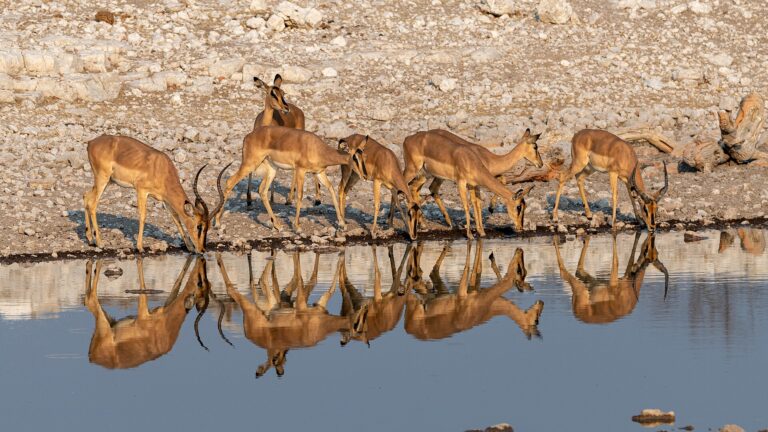
Place Olifantsbad waterhole in a realistic Etosha route
Do not confuse Olifantsbad with Olifantsrus
The similar names describe different places. Olifantsbad waterhole is a wildlife stop, while Olifantsrus is a western camp and viewing site. Check the map label, route and overnight plan carefully so navigation does not create a costly detour.
Use the stop as part of a cluster
Choose a small group of nearby roads and waterholes rather than attempting the entire park. The best route depends on the starting camp, current road openings and the deadline for return. Save the location offline and follow park signs over an app pin.
Set the turn-around time first
Calculate the slow return to camp or gate and add a wildlife buffer. The driver should know the departure time before watching begins. A late elephant arrival does not suspend park rules.
Check official notices
Waterhole access, tourist roads and detours can change. Follow signs and staff instructions. The official Etosha National Park overview is useful background, but conditions communicated inside the park take priority.
Approach Olifantsbad waterhole quietly
Slow down before the final bend
Animals may stand in the road or woodland before the basin becomes visible. Reduce speed early and avoid overtaking into the viewing area. A quiet approach can preserve behaviour already taking place.
Pause to understand the layout
Before choosing a position, identify the water, approach paths, shade, other vehicles and a way to leave. Do not form a wall between wildlife and water. If every clear space is occupied, wait farther back or return later.
Park for observation, not ownership
Use one legal position and switch off unnecessary sound. Keep the engine ready when safety requires it, but avoid repeated starting and shuffling for tiny photographic improvements. Share prime viewing space after a reasonable period.
Stay inside the vehicle
Windows are for viewing, not for leaning out or placing bodies beyond the vehicle outline. Doors remain closed near wildlife. Leave the vehicle only at authorised places and obey all signs.
Read Olifantsbad waterhole before looking for elephants
| Zone | What to scan | Possible clue |
|---|---|---|
| Water edge | Drinking animals, tracks, ripples and small birds | A partly hidden animal may be crouched or approaching. |
| Open ground | Herd spacing, alert postures and dust | Movement may be developing beyond the obvious group. |
| Mopane edge | Ears, trunks, horns and horizontal backs | Large animals can remain concealed close to the opening. |
| Sky and perches | Raptors, swallows and circling birds | Air movement and insects can create activity away from the water. |
| Road behind | Approaching animals and traffic | The sighting may be outside the front windscreen. |
Begin with binoculars
Scan left to right at several heights before moving the car. Binoculars reveal an ear in mopane, a small bird at the edge or a distant herd without forcing a closer position.
Watch the whole waterhole
The most obvious drinking group can distract from an approach on the opposite side. Passengers should divide the scene and communicate quietly. Avoid sudden pointing across another person’s camera or field of view.
An empty waterhole still has information
Tracks, dung, light, wind and water condition help explain what may have happened earlier. Wait for a defined period if the schedule allows, then leave without declaring the waterhole permanently unproductive.
What wildlife behaviour may mean at Olifantsbad waterhole
A drinking herd needs an exit
Antelope often drink quickly while some individuals remain alert. Do not block the direction they use to enter or leave. If heads rise and attention fixes on vehicles, reduce disturbance rather than trying for closer eye contact.
Elephants may wait outside view
A herd can pause in woodland until it feels comfortable approaching. Engines, doors, voices and a line of vehicles may delay or redirect it. Olifantsbad waterhole is more likely to support natural behaviour when observers keep space and noise low.
Different species do not follow a fixed script
Dominance, caution and timing can influence who reaches water, but a universal arrival order should not be assumed. Conditions change by day and individual. Describe what you observed instead of turning one sequence into a rule.
Birds can provide the closest action
Sandgrouse, doves, starlings, raptors or small waders may use the area depending on conditions. Watch rapid drinking, bathing and flight lines without playback or calls. A quiet bird sequence can be the strongest sighting while mammals remain distant.
Predators change the atmosphere
Alert antelope, a sudden empty edge or fixed attention can justify a careful scan, but it is not proof of a predator. If one appears, remain still, keep distance and avoid blocking an escape or hunting route.
Photograph Olifantsbad waterhole without forcing the scene
Use reflections deliberately
When the water is calm, leave space beneath drinking animals for a full reflection. Check the bottom edge for cut-off legs, horns or mirrored faces. A horizontal frame often suits a line of impala, while a vertical frame can isolate one subject and its reflection.
Expose for pale ground and bright water
Etosha soil and glare can push highlights toward clipping. Review the histogram and reduce exposure if necessary while preserving useful detail on the animal. Reflected sky may be brighter than the subject.
Choose behaviour over continuous bursts
Short bursts can capture a drinking head lift, crossing reflection or dust shake. Then release the shutter and watch. Endless firing fills storage and can make the photographer miss the next interaction.
Heat shimmer limits distance
Midday air can soften a far subject even with correct focus. A wider environmental frame may work better than extreme magnification. Do not drive closer only to defeat atmospheric distortion.
Protect the route into the frame
A photograph is not improved by placing the vehicle in an animal’s path. Compose with the available angle, wait or accept the wider view. The behaviour remains more important than a clean background.
How long should you wait at Olifantsbad waterhole?
There is no universal number. Use three limits: the wildlife signs, the group’s comfort and the firm travel deadline. A quiet stop with fresh tracks and approaching animals may justify patience; an empty stop during a tight transfer may not.
Use a first observation period
Give the scene enough time to settle after arrival. Scan all zones and note whether birds, wind or vehicle traffic are changing. Do not reposition immediately because another car has a longer lens.
Reassess instead of drifting
At a chosen time, ask whether new signs have appeared, whether the group is comfortable and how much buffer remains. Continue, leave or return later deliberately. Olifantsbad waterhole should not absorb the time needed for a safe exit.
Know when a sighting is complete
After the main behaviour ends or the viewing area becomes crowded, let another vehicle use the space. A final frame is rarely different enough to justify blocking the best angle.
Nine waterhole-etiquette checks
- Approach slowly and scan the road first.
- Leave animal routes to and from water open.
- Use one legal vehicle position.
- Keep voices, music and device sounds low.
- Do not call, feed or provoke wildlife.
- Share clear viewing space with other vehicles.
- Keep bodies and equipment inside as required.
- Depart before the camp or gate buffer becomes tight.
- Report hazards through appropriate park channels.
A patient Olifantsbad observation plan
| Phase | What to do | What it can reveal |
|---|---|---|
| Approach | Reduce speed, scan the verge and note dust or moving ears before the water is visible | Animals approaching from cover and the direction of recent movement. |
| Settle | Choose one legal position, quiet the cabin and prepare binoculars before moving a window or lens | Whether the scene relaxes once the arrival disturbance ends. |
| Scan | Work from the water outwards through mud, bank, trees and sky | Small birds, waiting antelope, raptors and animals using shade away from the obvious centre. |
| Wait | Watch repeated actions and changes rather than searching for one named species | Drinking order, vigilance, displacement and natural departures. |
| Leave | Check the return margin, start gently and look along the road before joining it | Wildlife behind the vehicle and a safe exit that does not interrupt the next arrival. |
Choose a position for observation, not ownership
The closest place is not automatically the best place. A slightly wider angle may show the approach route, reflections and interactions while leaving clearer space for other vehicles. Park parallel where appropriate, keep the road passable and avoid repeated small movements. Every reposition creates sound, dust and a new shape that approaching animals must assess.
If another vehicle already occupies the useful opening, wait at a respectful distance or return later. Do not squeeze into an animal path or obstruct the driver who arrived first. A calm shared sighting usually produces better viewing than a contest for the front metre.
Use a slow perimeter scan
Begin with the water surface, then scan the bank, nearby shade, grass edge and distant trees. Repeat the same circuit every few minutes. An animal can remain motionless until the observer learns the shapes of the scene. Birds may arrive above the mammals, and predators may be visible only as an ear, tail or change in the behaviour of prey.
Binoculars help confirm detail without demanding that the vehicle move closer. Let each passenger describe a location with a clock face or fixed landmark. Clear directions reduce excited pointing and allow everyone to find the subject with less noise.
Read behaviour before species lists
Notice which animals drink immediately, which wait, and which leave after looking toward the same place. Record what is visible without assigning an unsupported cause. A herd that stops may have detected scent, sound, another animal or vehicle movement; unless the trigger is seen, the honest conclusion is simply that its behaviour changed.
Watch individuals as well as the group. Young animals, males and mothers may use different spacing, and one alert individual can influence many others. The value of Olifantsbad waterhole lies in these relationships even when the hoped-for elephant does not arrive.
Make photography support the wait
Set a general exposure and shutter speed before action begins, then rest the camera on a secure support. Continuous lens changes, burst testing and discussions about settings disturb the cabin and increase dust on equipment. Capture a wide establishing frame, a behaviour sequence and a final habitat image instead of hundreds of identical drinking photographs.
Heat shimmer, backlight and reflections can be used creatively, but they can also reduce detail. Review a small sample without staring at the screen for the rest of the stop. The next interaction is more valuable than perfecting a photograph of behaviour that has already ended.
Decide how the stop will end
Set a departure time based on the next camp, gate or junction, and keep a separate buffer. If a strong sighting begins near that time, use only the buffer deliberately and remove a later stop. Never recover the lost minutes by speeding. When leaving, wait for animals and vehicles to clear, close loose equipment and accelerate gently.
A quiet departure protects the final moments and keeps the waterhole available to the next visitor. Record notes at an authorised rest area, not while the driver is negotiating wildlife and traffic.
Know what to do when the waterhole looks empty
An empty first scan is not a failed stop. Check shade, mud, distant approaches and the sky, then listen. Small birds, tracks and changes in other animals can make the site informative before a large mammal arrives. Set a reasonable wait that fits heat, passenger comfort and the return route. If nothing changes, leave without trying to call or lure wildlife.
A second visit at another legal time may feel completely different, but it is still not a guarantee. Treat each stop as a fresh observation shaped by weather, water, disturbance and animal movement.
Use a repeat visit for comparison
If the itinerary passes Olifantsbad waterhole again, park with the same quiet routine and compare water level, wind, shade and species present. Repeated observation can reveal change without claiming a fixed daily pattern. Note exceptions as carefully as repetitions, and never lengthen the return route merely to reproduce an earlier sighting.
Compare photographs only after the drive. Look for changes in bank access, background vegetation and the number of waiting animals, while remembering that two visits cannot establish a permanent rule. The exercise is useful because it trains observation and shows how quickly a familiar place can change.
If the second stop is crowded or the available position would pressure wildlife, continue. Responsible repeat viewing includes accepting that the conditions no longer support the planned wait.
Use the route map to decide whether a later return is genuinely efficient. Doubling back across a large sector for one named waterhole can remove time from several quieter stops. Olifantsbad should fit the day’s geography, not dominate it. The better choice may be to keep moving and apply the same patient method at the next safe viewing place.
Before committing to that detour, compare the direct distance to camp with the waterhole loop and include the time needed to wait. If the calculation removes the legal return margin, skip the stop. An Olifantsbad waterhole visit is most rewarding when patience is available; a rushed drive-by adds traffic and rarely reveals behaviour. Mark it as an option for another day rather than a promise the itinerary must keep.
Common Olifantsbad waterhole questions
Will I see elephants?
They use the area, but no wild sighting is guaranteed. Season, water availability, disturbance and daily movement all matter. Enjoy the species and behaviour that are present.
Is Olifantsbad the same as Olifantsrus?
No. They are separate places. Verify the map and overnight route before setting out.
What is the best time to visit?
Cooler periods often bring activity and softer light, but timing varies. The best visit is one that fits the route, current conditions and safe return.
Can I get out for a better photograph?
No. Remain in the vehicle except at authorised locations and follow park instructions. A lower angle is never worth breaching a safety rule.