
Leopards in Etosha are found through patient habitat reading more often than through a frantic chase after a sighting report. Slow down at woodland edges, mature trees, rocky ground and drainage lines; scan for shape, tail, shadow and prey attention; then accept that the cat may remain invisible.
Finding leopards in Etosha does not require the cat to sit in a tree or walk in the open. It may lie behind grass, rest in dense shade or pass through a gap in seconds. The best search gives each promising patch enough time for detail to resolve without blocking the road, leaving the vehicle or disturbing other animals.
This guide improves observation technique rather than promising a location for leopards in Etosha. Recent sightings become old quickly, roads and vegetation change, and individual cats do not follow a visitor timetable. Treat every leopard as a rare reward within a broader wildlife day.
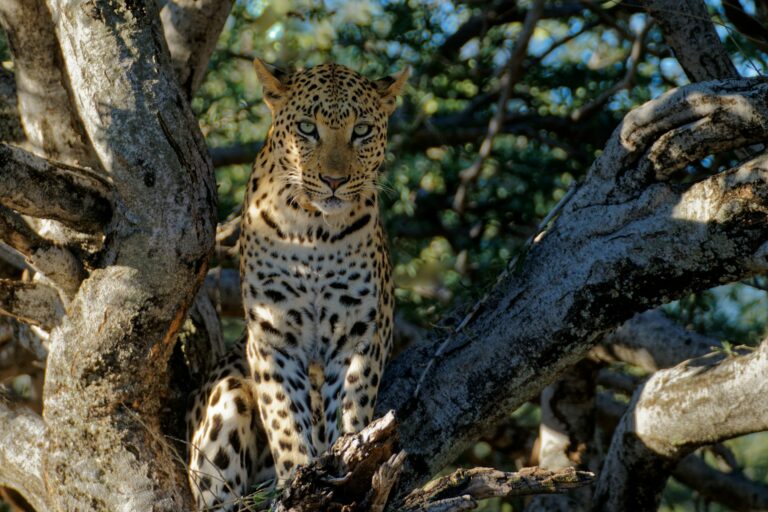
Where to look for leopards in Etosha
Leopards use cover, terrain and opportunity. In Etosha, a useful search concentrates on transitions: dense mopane meeting an opening, a drainage line crossing the road, scattered mature trees near prey, a rocky rise above flatter ground or a shaded approach to water. These are search zones, not guaranteed territories.
| Habitat clue | What to scan | Common mistake |
|---|---|---|
| Woodland edge | Low branches, horizontal limbs, shade pockets and ground beneath trees | Looking only into the canopy |
| Rocky rise | Ledges, cavities, warm rock edges and connecting cover | Scanning only the highest boulder |
| Drainage line | Dense banks, crossings, fallen timber and game paths | Driving through without pausing |
| Water approach | Cover near—not only at—the water | Watching the open water exclusively |
| Open-to-cover transition | First shade line and paths used by prey | Searching open plains for too long |
Think in routes, not isolated trees
A tree is more interesting when it connects shade, prey movement and cover. Trace the line from the trunk to nearby brush, rocks or a dry channel. Leopards in Etosha can move along these connected features without exposing their full outline.
Cover can be thin
Do not dismiss a low shrub, grass clump or small erosion channel. A spotted coat breaks into light and shadow, allowing an adult cat to disappear in surprisingly sparse vegetation. Scan the same patch from more than one legal road angle if the route naturally provides it.
Water is only part of the picture
Leopards may drink or investigate prey near water, but crowded open waterholes are not the only option. Search the approaches, nearby shade and routes between habitat features. Never park across an animal path or wait so close to cover that the cat cannot emerge comfortably.
How to search woodland for leopards in Etosha
Start low, then move upward
Scan the ground beneath the canopy, fallen logs and the first horizontal limbs before looking high. A leopard may rest on the ground in deep shade or use a low fork. Starting at the top encourages the eye to skip the darkest and most likely hiding places.
Look for parts, not a whole cat
- A tail hanging below a branch.
- A rounded ear above grass or behind a limb.
- The pale underside of a body in shade.
- A foreleg or paw breaking the line of a branch.
- Spotted texture that does not match bark.
- A branch appearing unusually thick or asymmetric.
- Eyeshine only when observed naturally and without spotlighting.
Use binoculars before the long lens
Binoculars provide a wider field and faster way to search for leopards in Etosha than a super-telephoto lens. Divide the woodland into panels, sweep each slowly and return to suspicious shapes. After locating a subject, use the camera. Searching through a narrow lens can miss movement a few metres to the side.
Change focus depth
The eye tends to settle on the front row of branches. Deliberately scan foreground, middle shade and background gaps. Leopards in Etosha may be visible through two or three layers of vegetation only when the observer changes focus.
Do not assume every elevated cat has a kill
Leopards climb for rest, safety, view and to secure prey, but a tree sighting does not prove that a carcass is present. Avoid circulating an unverified kill report. Describe what you can actually see.
Search rocky areas without staring at one outcrop
Scan edges and connecting cover
Rocky areas create ledges, cavities, shade and viewpoints for leopards in Etosha, but the useful search extends to the brush and drainage lines leading away. A leopard may rest at the base rather than on the skyline. Follow the contour with binoculars and check each transition from light to shadow.
Use side light carefully
Low-angle light can reveal the curve of a back or spotted coat, while harsh midday contrast can hide a cat in black shade. Do not assume noon is useless: shade becomes predictable and the search can focus on cool recesses, tree bases and rock overhangs.
Watch for an unnatural line
A tail is smoother than a branch; a shoulder forms a curve unlike broken rock; ears repeat a rounded shape. Train the eye on structure rather than colour. The coat of leopards in Etosha often matches dry grass, stone and dappled shade remarkably well.
Do not leave the road or vehicle
Rocky ground may tempt a passenger to step out for a better angle. Do not. Stay on indicated roads, remain inside except at authorised places and follow permit and staff instructions. Off-road driving damages habitat and pressures the animal even when another vehicle has already done it.
Use prey and bird behaviour as clues
Attention direction matters
When searching for leopards in Etosha, several antelope facing the same patch of cover, repeated snorting or a herd moving away can justify a careful scan. It does not prove a leopard; lions, hyenas, jackals, people or an unfamiliar sound can produce vigilance. Read the direction and duration before drawing a conclusion.
Alarm calls require context
Birds and squirrels can advertise a predator, but they also call for other threats and social reasons. Find the caller, note where it is looking and scan that line. Never play calls or imitate wildlife to produce a reaction.
A quiet absence can be a clue
Prey that normally use an opening may bunch at the edge or avoid a path. This is subtle and easily overinterpreted. Use it to slow down, not to announce a leopard. Good fieldcraft leaves room for being wrong.
Tracks are information, not a chase command
A track on the road confirms that a cat passed, but substrate, wind and traffic affect how long it remains visible. Do not follow tracks off-road or block a guide who is interpreting them. A qualified guide can explain size, direction and freshness without promising the animal is nearby.
The conservation organisation Panthera’s leopard overview provides wider species and conservation context. Use general ecology to improve respect for the search, while relying on current park guidance for Etosha routes and rules.
When to search for leopards in Etosha
Dawn and late afternoon are useful, not magical
Cooler periods can increase movement and improve scanning light, but a leopard may have settled before the gate opens or remain active later. Build dawn and late drives around habitat variety rather than a promise that the cat will cross the road.
Midday can reveal a resting animal
At midday, focus on deep shade, sturdy branches, rock overhangs and quiet drainage cover. Sitting at one habitat edge for several minutes may reveal a tail flick or head lift that a moving vehicle misses. Keep the engine decision with the driver and preserve an exit route.
After rain, the search changes
Vegetation can thicken, water becomes more dispersed and road conditions alter. Leopards in Etosha do not disappear, but open-water predictability may decline and green cover makes scanning different. Follow closures and avoid extrapolating dry-season tactics to every month.
One reported sighting should not erase the day
A message from an hour ago may refer to a cat that moved into cover. Chasing it across sectors wastes observation time and encourages speeding. If the location fits the planned route, scan responsibly; otherwise continue with the habitat already in front of you.
A safe vehicle search routine
- Slow down before the promising habitat, not after passing it.
- Check mirrors and traffic before stopping.
- Leave enough room for other vehicles to pass.
- Scan ground, low branches, middle canopy and connecting cover.
- Use binoculars for the wide search and a camera after detection.
- Listen for natural alarm behaviour without playback.
- Move on when the stop creates congestion or pressures wildlife.
- Record the habitat and behaviour, not only a map pin.
- Never exceed the return-time margin for a rumour.
Give every passenger a zone
The left-side passenger scans the left near and middle ground; the right-side passenger mirrors the method; a rear passenger checks deeper gaps and behind the vehicle. Rotate quietly. This organised search for leopards in Etosha finds more than everyone staring at the same obvious tree.
Use one descriptive alert
When someone sees a candidate, say “large fork, lower branch” rather than shouting. The driver stops safely. Confirm spots, rosettes, body shape and movement before announcing a leopard to nearby vehicles.
Keep children engaged with shapes
Ask children to find hanging tails, rounded ears and shadow curves, not to call the animal. A short woodland game can improve attention without turning the drive into pressure. Binoculars must fit safely and stay inside the vehicle outline.
The Etosha leopard guide adds species background, while the Etosha safari guide helps match habitat searches to a realistic sector plan.
What to do when you find a leopard
Stop before blocking the cat
Leave the road, cover and intended direction open. Do not form a vehicle semicircle around the animal or park beneath its tree. If movement, head position or repeated looking shows pressure, increase space.
Share room, not demands
Take a few frames, then allow another vehicle a clear angle where safe. Keep engines, voices and equipment quiet. A sighting of leopards in Etosha can attract traffic quickly; the first vehicle sets the tone.
Do not lure a look
No clicks, whistles, roars, food, prey noises or call recordings. The animal decides where to look. Avoid flash and follow current park rules. A natural rear view is better than a forced face.
Keep sensitive details off live social media
Real-time coordinates can produce a rush and may expose a resting cat, cubs or a carcass. Share later and describe the sector broadly when appropriate. A guide or researcher may use precise data through a responsible channel.
Leave before the crowd becomes the story
If vehicles block traffic, passengers lean out or the cat becomes alert, depart calmly. The value of finding leopards in Etosha is not measured by minutes at any cost. A short undisturbed encounter is a successful one.
Nine leopard-search cues to remember
- Transitions between open ground and cover.
- Ground shade beneath mature trees.
- Low horizontal branches and hanging tails.
- Drainage lines and fallen timber.
- Ledges, rock bases and overhangs.
- Several prey animals watching one direction.
- Natural alarm calls with a clear focus.
- Quiet movement at cooler times.
- Enough patience to accept no sighting.
Common questions about leopards in Etosha
Are leopards common in Etosha?
They are part of the park’s wildlife, but sightings are difficult because leopards are solitary, camouflaged and often use cover. “Present” does not mean easy to see on a short visit.
Should I look only in trees?
No. Scan the ground, low branches, drainage lines, rocks and paths between cover. A tree is one resting option, not the leopard’s permanent location.
Is dawn the only useful time?
No. Cooler hours can improve movement chances, while midday shade may reveal a resting cat. Match the scan to light and habitat throughout the day.
Can a guide guarantee a leopard?
No ethical guide can guarantee one. A guide can improve habitat reading, interpret signals and manage the vehicle responsibly, but wildlife remains unpredictable.