
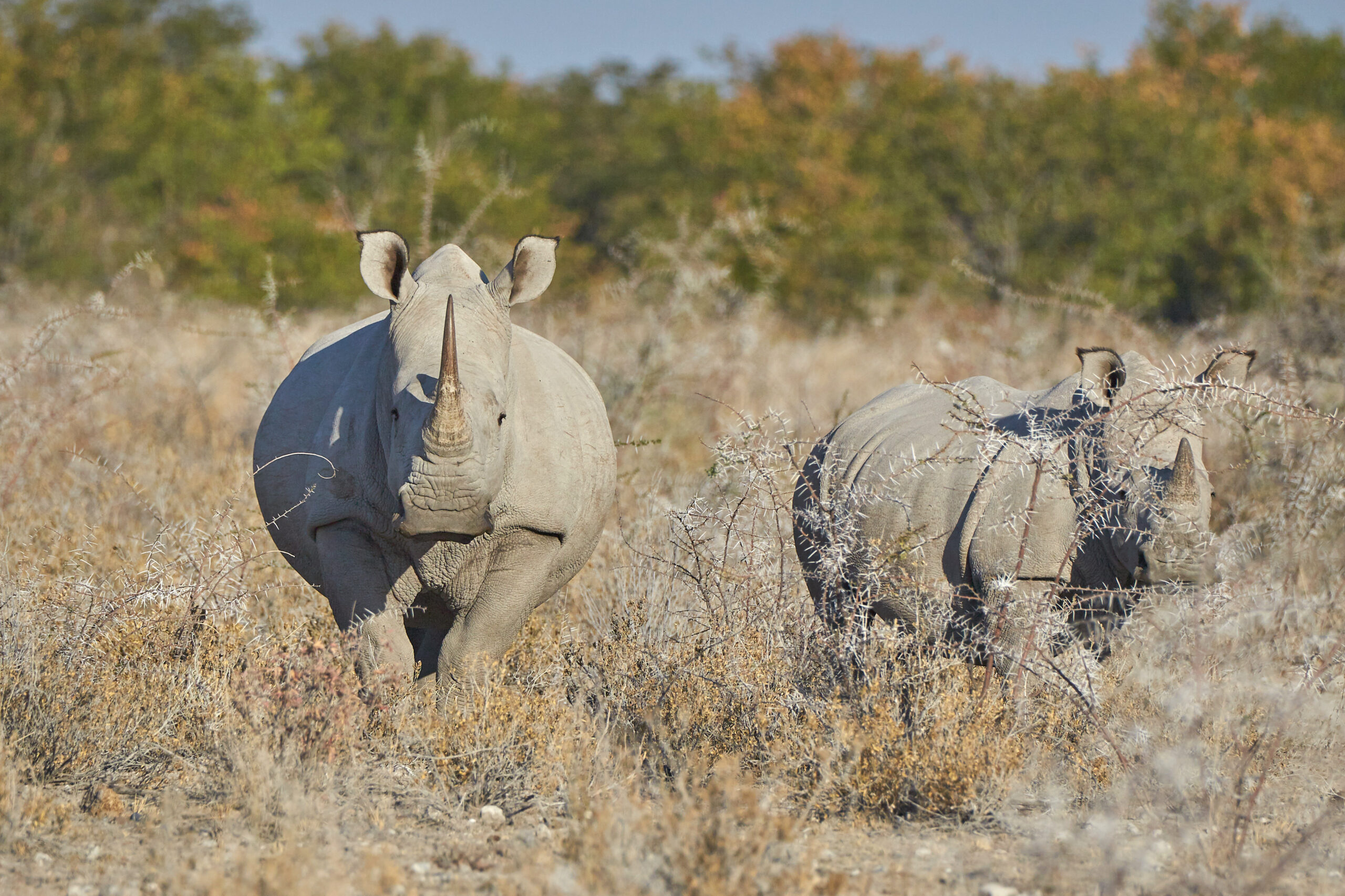
White rhinos in Etosha are most reliably identified by a combination of features: a broad square-looking mouth adapted for grazing, a head often carried low, a relatively long front to the skull and a body profile suited to feeding on grass. Colour is not a useful distinction from black rhinos.
Identification should never turn into pursuit. Rhinos are powerful wild animals, locations can be sensitive and other vehicles deserve space. Stay on authorised roads, follow park instructions and allow the animal to choose its direction.
A distant, peaceful observation is more valuable than a close encounter created by blocking a route. This guide focuses on structure, behaviour and respectful field practice rather than promising where to find rhinos.
In this guide
- Why colour does not identify the species
- Mouth, head and body shape
- Grazing behaviour and habitat
- Calves and social behaviour
- White versus black rhino
- Nine respectful viewing rules
Why “white” is not a colour test
White and black rhinos can both appear grey, brown or pale depending on dust, mud and light. Do not identify the species from colour or from a distant impression of size alone.
Begin with the mouth and feeding posture. Then add ear position, head carriage, back profile and habitat. No single feature is perfect at every angle, so wait for several clues.
The broad grazing mouth
White rhinos are also called square-lipped rhinos because the mouth is wide and straight across the front, suited to cropping grass. When the head is down, binoculars may reveal the broad muzzle sweeping close to the ground.
A black rhino usually has a more pointed, hooked upper lip adapted for browsing shrubs. Distance and vegetation can hide the mouth, so avoid forcing an identification when the key feature is not visible.
| Clue | White rhino tendency | Caution |
|---|---|---|
| Mouth | Broad, square-looking grazing lip | Often hidden in grass |
| Head carriage | Frequently low while feeding | Changes when alert |
| Diet | Primarily grass | A single bite is not proof |
| Body impression | Long, heavy and broad | Angle distorts size |
Head, ears and body profile
The white rhino’s long head and prominent shoulder hump support a grazing posture. Ears are large and mobile, continually sampling sound. The back may appear to dip behind the shoulder before rising toward the rump.
Use these features as a group. Mud, grass and a rear-facing angle can obscure them. A photograph taken without changing position can help later comparison with a field guide.
Grazing behaviour adds evidence
A white rhino may walk steadily with the head low, cropping grass in a broad sweep. It can spend long periods feeding, then raise the head to listen or scent. At a waterhole, the mouth may be easier to see when the animal turns.
Habitat is supporting evidence, not a rule. White rhinos favour grassy areas, but either species can move through mixed vegetation or visit water. Do not label every rhino on open ground as white.
Let an experienced guide add behaviour and context
A guided Etosha drive can help distinguish grazing and browsing clues while maintaining safe distance. Choose an authorised activity and a well-located stay.
Calves and group spacing
Females may be accompanied by calves, and white rhinos can sometimes be observed in loose social groups. Give a mother and calf additional space. A calf’s movement can be unpredictable, and the adult may position herself defensively.
Never separate individuals with the vehicle, stop between an animal and water, or surround a group with other cars. If the rhino changes direction repeatedly because of traffic, reduce pressure and leave.
Protect sensitive location information
Do not publish real-time rhino locations, precise map pins or repeated movement details. Follow park and conservation guidance on sharing sightings.
White rhino versus black rhino in Etosha
The site’s black rhino viewing guide explains the pointed browsing lip and respectful observation principles for that species. Compare mouth and feeding style before relying on temperament or body size.
Save the Rhino International describes the white rhino’s square lip and grass-feeding adaptation. Use reputable species information and keep uncertain sightings uncertain.
Nine rules for watching white rhinos in Etosha
Calm vehicle behaviour protects both the animal and the quality of the sighting.
- Stay on authorised roads.
- Stop at a respectful distance.
- Leave the animal an open route.
- Keep voices low and movement slow.
- Switch off flash and bright lights.
- Do not publish a precise live location.
- Avoid crowding a mother and calf.
- Move away if behaviour changes because of vehicles.
- Report suspicious activity through official channels.
Photography without closing the distance
Use the lens available rather than repositioning repeatedly. A wider frame showing grassland, dust and other species can tell a stronger conservation story than an extreme close-up.
Watch exposure on pale dust and harsh midday light. Photograph short sequences, lower the camera and observe. Engine noise, door movement and passengers changing seats can all disturb a close animal.
What respectful observation contributes
Accurate identification and low-pressure viewing help guides, visitors and conservation staff maintain a culture of care. Avoid public speculation about population numbers or security operations unless an authoritative source provides current information.
The privilege of seeing a rhino comes with restraint. Leave no food, waste or location trail that increases risk, and choose tours or accommodation providers that follow park rules.
White rhinos in Etosha questions
Identification becomes more reliable when mouth, posture, diet and context agree.
Are white rhinos actually white?
No. White and black rhinos can both appear grey or brown. Use mouth shape, feeding behaviour and body profile instead of colour.
What is the best identification clue?
The broad, square-looking mouth adapted for grazing is the strongest field clue when visible. Confirm it with low head carriage and grass feeding.
How does a black rhino mouth differ?
A black rhino generally has a pointed, hooked upper lip used to browse leaves and twigs. Angle and vegetation can hide the difference.
Are white rhinos larger?
They are generally the larger species, but distance, age and viewing angle make size unreliable on its own. Structure and feeding style are better clues.
Where can white rhinos be found in Etosha?
Do not seek or share precise locations. Rhinos move, sightings are not guaranteed and location information can be sensitive. Use lawful roads and current guide knowledge.
What should a vehicle do if a rhino approaches?
Remain calm, keep an escape route for the animal, follow guide or park instructions and avoid sudden movement. Do not start the engine or reposition unless necessary for safety.
Can visitors photograph a calf?
Yes from a respectful legal position, but never crowd or separate a calf from the adult. Reduce pressure immediately if the mother changes behaviour.
Why avoid live location sharing?
Precise real-time information can create crowding and security risk. Share the experience without a map pin or movement detail.
Are white rhinos aggressive?
Any rhino can be dangerous when surprised, crowded or threatened. Temperament stereotypes are not a safety system; distance and park rules are.
What if the identification remains uncertain?
Record the features you saw and label the sighting as uncertain. A careful unknown is better than a confident error.
A practical white rhinos in Etosha note
Use this white rhinos in Etosha guide as a planning aid, then confirm conditions with park staff, accommodation hosts or an authorised guide. A sound white rhinos in Etosha decision combines current local information, realistic driving time and respectful behaviour. Keep this white rhinos in Etosha checklist available offline, and adapt the white rhinos in Etosha plan when weather, wildlife activity or gate times change.
Watch Etosha rhinos with restraint
Learn the field marks, protect sensitive locations and choose observation that lets the animal continue naturally. Responsible viewing is part of conservation.