
An Etosha game drive is better as a private departure when your group values control over pace, stops, seating and special interests. A shared departure is usually better when per-person cost, a social atmosphere and a ready-made schedule matter more. Neither format creates better wildlife on demand.
The comparison should begin with the vehicle and guide, not the label. A well-run shared drive with sensible occupancy and a strong guide can outperform a poorly specified private vehicle. Ask how many guests share each row, whether every seat has a clear side view, how long the drive lasts and which sector it normally covers.
This guide compares the practical trade-offs for couples, solo travellers, families, photographers and mixed-mobility groups. It also explains what an Etosha game drive can add to a self-drive itinerary and which booking questions reveal more than a generic “private” or “shared” description.
Private vs shared Etosha game drive at a glance
| Priority | Private drive often fits | Shared drive often fits |
|---|---|---|
| Budget | Larger group sharing one vehicle price | Solo traveller or couple paying per seat |
| Pace | More control over stops and interests | Fixed departure with fewer decisions |
| Photography | Seat planning and longer observation | Works when occupancy and etiquette are good |
| Family routine | Breaks and attention matched to children | Older children comfortable with a set schedule |
| Social experience | Privacy for your own group | Conversation with other travellers |
| Special interests | Birding, behaviour or habitat focus | Broad first-time introduction |
| Wildlife guarantee | None | None |
Do not decide from the table alone. Ask for the final total price, maximum passenger count, cancellation terms, pickup point and duration. A “private” rate may exclude park fees or transfers; a “shared” rate may include them. Compare the same set of inclusions.
When a private Etosha game drive earns its price
You control the observation rhythm
A private Etosha game drive can spend more time on one quiet behaviour: a raptor scanning, elephants negotiating space or antelope reacting to a distant predator. The guide still follows park rules, other guests’ access and the return deadline, but the group does not need to vote between a birding stop and the next waterhole.
Seats can be planned deliberately
Photographers can discuss which side of the vehicle suits the light and whether equipment can be secured between stops. Families can place an adult beside each child. Guests who struggle to climb can request an accessible position. Confirm this before payment; private use does not alter the physical vehicle.
The guide can match prior knowledge
A first-time visitor may want the broad Etosha story, while an experienced birder wants age, moult, calls and habitat. In a private vehicle the guide can set the explanation level around one group. This is valuable only if interests are communicated in advance.
Timing can fit the group—within limits
Some operators can adjust pickup or the balance between driving and waiting. Park opening, camp-return times, guide working hours and the operator’s logistics still apply. “Private” never means unrestricted access, off-road driving or a night drive where that activity is not authorised.
A private Etosha game drive is especially useful for a family with young children, a serious photography session, a mobility requirement or a once-only specialist interest. It is less useful when the group simply wants a standard route and will not use the extra flexibility.
When a shared Etosha game drive is the smarter choice
Per-person cost is usually clearer
For a solo traveller or couple, buying seats on a shared Etosha game drive is often more economical than taking the whole vehicle. Compare the final price with park fees, pickup and refreshments included or excluded. The lowest headline rate can become poor value when the transfer is long or the drive is short.
A fixed departure simplifies the day
Shared drives have a stated meeting time and route framework. That can be helpful after a long self-drive or for travellers who prefer the operator to set the rhythm. Arrive early: one late passenger reduces everyone’s limited wildlife time.
Other guests can improve the search
More attentive eyes may notice movement or birds, and a mixed group can make the day sociable. The same mix can also create competing priorities. A good guide explains the plan, rotates opportunities fairly and prevents one passenger from directing every stop.
A shared vehicle can still be spacious
“Shared” does not mean full to the last legal seat. Some operators limit occupancy so each passenger has a side view. Ask for the operational maximum, not only the vehicle’s licensed capacity. A well-spaced shared Etosha game drive can be comfortable for binoculars and modest camera gear.
Choose shared when the schedule fits, the seating is clear and the group is comfortable accepting a broad wildlife route. If a single missed photograph or bathroom timing will cause frustration, the saving may not justify the loss of control.
Inspect the Etosha game drive vehicle and seating
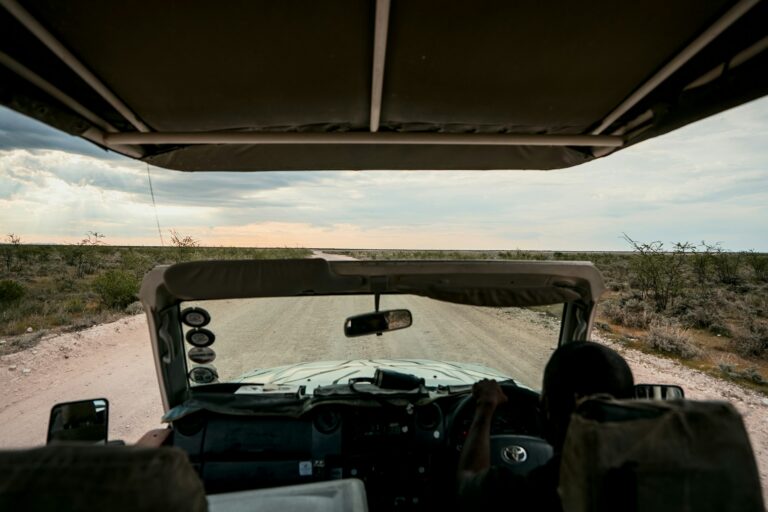
Vehicle design affects comfort more than a private/shared label. Open-sided raised vehicles improve sightlines and communication, but cold air, wind and dust can be intense. Closed vehicles offer climate protection yet may limit angles. Ask for a current vehicle photograph and whether the actual departure may use a different type.
Nine vehicle details worth asking
- Maximum guests on the booked departure.
- Number of seats per row and side-view access.
- Canopy, rain cover and wind protection.
- Steps, handholds and assistance for boarding.
- Seatbelts and child-seat policy.
- Space and restraints for camera equipment.
- Blankets or cold-weather gear on dawn drives.
- Communication between rear seats and guide.
- Emergency water, first aid and vehicle backup procedure.
The front seat is not automatically best
A front seat may provide guide conversation and wind protection but can have a lower angle or obstructed side. A rear raised seat can see over vegetation but feel bumpier. For an Etosha game drive, ask what view each position offers and request—without demanding—a seat aligned with your needs.
Camera gear needs a storage plan
Long lenses, tripods and bags can block aisles or neighbouring seats. Tell the operator what you will bring. A beanbag and one prepared camera are often more useful than several unsecured cases. Shared guests should not claim an empty seat unless it has been paid for or assigned.
Guide quality and route design matter most
A strong guide does more than name animals. They interpret tracks, habitat, alarm behaviour, weather and the limits of a sighting. They position legally, reduce disturbance, share space with other vehicles and know when to leave a crowded waterhole.
Ask how the route is chosen
Some drives follow a reliable sector loop; others adapt to recent conditions. Neither is automatically superior. A fixed loop can cover varied habitats efficiently, while a flexible route responds to rain, road closures and current movement. The guide should describe a method without guaranteeing species.
Check sector and pickup before booking
An Etosha game drive from the wrong gate can spend too much time on transfers. Match the operator to Okaukuejo, Halali, Namutoni, Dolomite or the outside lodge’s authorised activity area. Clarify whether the drive is inside the national park, on a private reserve or a combination; each can be rewarding but they are not interchangeable.
The Etosha National Park safari guide compares the main sectors. Use it to choose a base before selecting the departure.
Use professional signals
Clear written inclusions, realistic wildlife language, current vehicle information and direct answers about accessibility are stronger signals than a long species list. The Tour and Safari Association of Namibia provides industry context and member information; verify the specific operator, insurance and terms directly.
Match the Etosha game drive to the traveller
Solo travellers
A shared drive usually offers the best value and an easy social setting. Check that the departure is confirmed with a minimum number of guests. A private option may suit a solo photographer who values a specific seat and can justify the whole-vehicle cost.
Couples
Shared drives work well when both travellers have broad interests and the seating is comfortable. A private Etosha game drive may be worth it for an anniversary, proposal, intensive photography or a tight one-day window, but privacy should not be confused with guaranteed solitude at public waterholes.
Families
Private vehicles offer control over breaks, explanations and attention spans. Confirm minimum age, child-seat policy, open-vehicle safety and toilet arrangements. Older children who can sit quietly for the full duration may enjoy a shared drive. Never hide a child’s age or book an activity that the operator says is unsuitable.
Photographers
Private generally wins when every passenger has serious equipment and wants repeated positioning. A shared Etosha game drive can still work with a side seat, modest kit and cooperative group. Ask whether repositioning is possible without disturbing wildlife or blocking others.
Guests with mobility or sensory needs
Discuss steps, seat height, vehicle access, bathroom timing, dust, cold and communication before payment. Private departures create flexibility but do not make an inaccessible vehicle accessible. Request measurements or photographs when the answer matters.
Self-drivers
One guided drive can complement a self-drive by teaching habitat scanning, tracks and park rhythm. Book it early in the stay, then apply the method to later loops. A dawn or late-afternoon guided session also gives the usual driver a rest.
Questions to ask before paying
- Is this a private vehicle or a private row?
- What is the maximum and expected guest count?
- Which vehicle is normally used?
- Where and when is pickup, and how long is the drive?
- Which Etosha sector or private reserve does it cover?
- Are park fees, refreshments and transfers included?
- What are the cancellation and minimum-passenger terms?
- What is the child and accessibility policy?
- Can special interests be requested without a sighting guarantee?
Compare total wildlife time
A six-hour product with a two-hour round-trip transfer is not the same as six hours of game viewing. Ask for the approximate time from pickup to the gate and the usual entry process. A shorter Etosha game drive from the right base may offer more observation than a longer headline duration.
Treat wildlife promises as a warning
No ethical operator can promise a lion, rhino, leopard or elephant. Recent sightings help a search but do not schedule animals. Choose the guide for fieldcraft, communication and responsible behaviour, not a guaranteed Big Five claim.
Nine private-vs-shared decision prompts
- How many people are paying?
- Which seats does the booking secure?
- Does anyone need a flexible break?
- Is photography a main purpose or a bonus?
- Will specialist birding or behaviour interests dominate?
- Does the fixed shared schedule fit the gate and meals?
- Is the private premium buying useful control?
- Which operator gives the clearest vehicle and route answers?
- Would one guided drive plus self-drive days give better value?
Common Etosha game drive questions
Will a private drive see more wildlife?
Not automatically. It can spend longer at productive sightings and adjust the route, but animals remain unpredictable. Guide skill, sector, weather, season and time often matter more than whether other guests share the vehicle.
Is a shared drive suitable for photography?
Yes, when occupancy leaves a clear side view and passengers coordinate. Bring compact, secured equipment and accept that the vehicle cannot serve one camera exclusively. Serious multi-lens work is usually easier privately.
Should a self-driver still book a guide?
Often, yes. One early guided Etosha game drive can demonstrate scanning, alarm signals, tracks and positioning while the main driver rests. It need not replace the freedom of later self-drive loops.
Can a private vehicle leave the public roads?
No, unless the specific activity is authorised in an area with different rules. Private use does not override Etosha National Park regulations. Ask whether an activity is inside the park or on a private reserve and follow the applicable rules.