
Cheetahs in Etosha are often associated with open plains, yet “open” does not mean easy to search. Pale grass, heat shimmer, low folds in the ground and scattered shrubs can conceal a resting cat. The best approach is patient, layered scanning from a legal road position—not rapid driving or joining every cluster of vehicles.
A cheetah sighting can never be promised. Habitat gives observers a reason to slow down, not a formula. Cheetahs also use more cover than the familiar grassland stereotype suggests, and their very large home ranges mean an apparently ideal plain may be empty during your visit.
Why cheetahs in Etosha use open-plains habitat
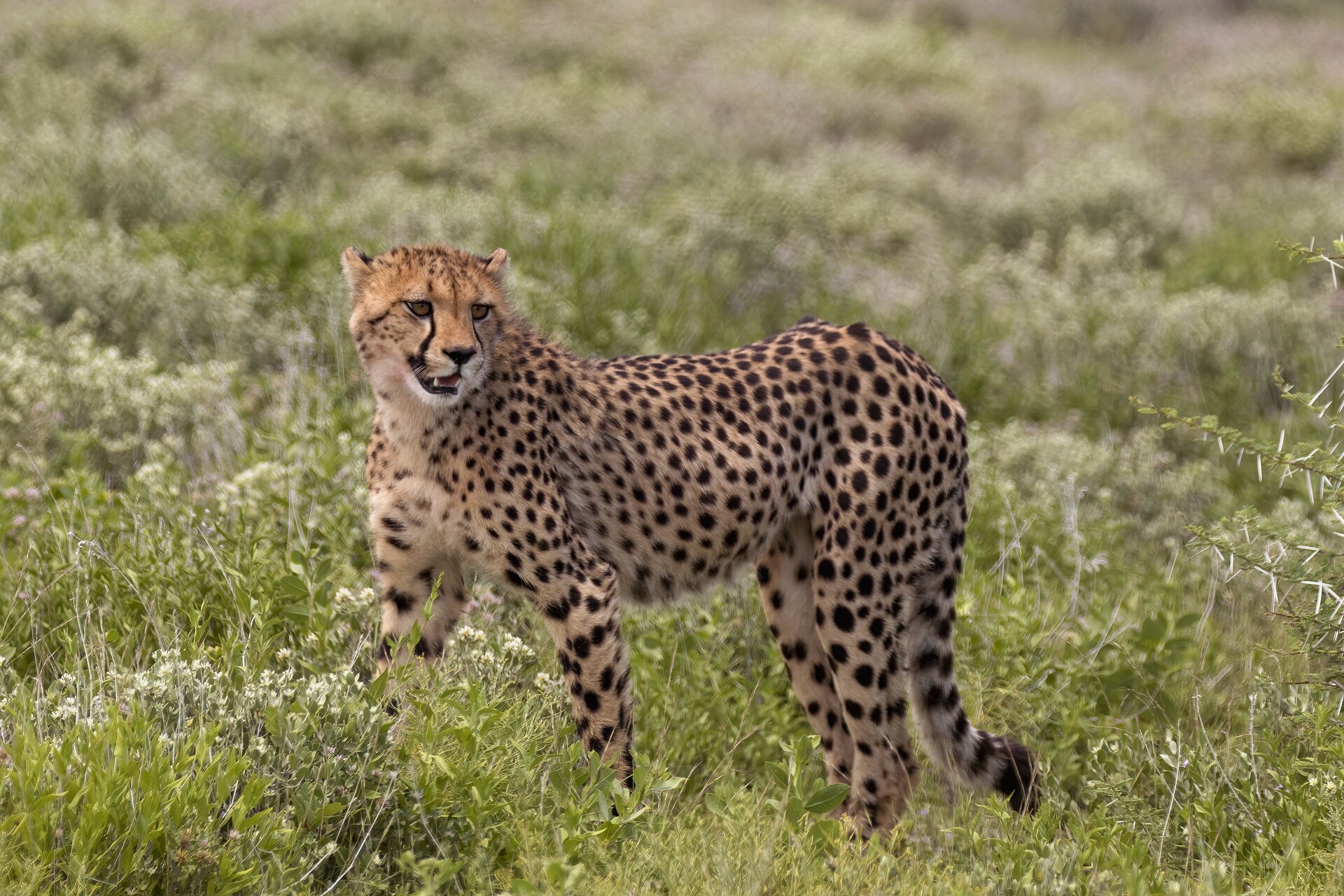
Cheetahs depend on a combination of prey, space and cover. The Cheetah Conservation Fund explains that Namibia holds an important cheetah population and that habitat loss remains a major threat. Open grass can support visibility and acceleration, while low vegetation, drainage lines and shade offer concealment and rest.
Etosha’s official vegetation description includes grass and dwarf-shrub land as well as shrubland and woodland. For visitors, the practical lesson is to scan the transitions: where short grass meets taller growth, where a pan edge rises slightly, and where isolated shade breaks the plain.
| Habitat feature | Why it deserves a scan | Common mistake |
|---|---|---|
| Low rise or ridge | A cat may use the elevation to watch prey | Scanning only flat ground beside the road |
| Grass–shrub transition | Cover and visibility meet | Assuming a cheetah will stand fully exposed |
| Isolated shade | Useful resting place in heat | Looking only for an upright silhouette |
| Open area with antelope | Potential hunting landscape | Interpreting every alert animal as proof of a predator |
How to scan open plains for cheetahs in Etosha
Stop where it is safe and permitted, switch off the engine when appropriate and begin without binoculars. Sweep the near ground first, then the middle distance and horizon. Overlap each visual strip so a low animal is not missed between jumps.
After the broad sweep, use binoculars to inspect suspicious shapes. Look for a small rounded head, a long horizontal back, a tail extending beyond grass or a repeated pattern of tan and black that does not move with the wind. Recheck termite mounds, shade edges and the base of shrubs.
The two-pass method
- Scan left to right with the unaided eye.
- Repeat right to left through binoculars.
- Pause on every shape that breaks the vegetation pattern.
- Ask another passenger to scan a different distance band.
- Move only after a defined quiet interval.
Use prey behaviour as a clue, not a conclusion
Springbok or other antelope facing the same direction can justify a careful scan. So can repeated alarm posture, bunching or sudden movement. Those signals may also relate to another predator, a vehicle, people, wind or social behaviour. Record what changed without claiming a cause you did not see.
Do not drive toward the direction of an antelope’s gaze if the road, traffic or animal space makes that intrusive. The goal is observation from an existing legal route. If a cheetah appears, the most useful position is one that keeps its travel line open.
Responsible viewing of cheetahs in Etosha
- Remain in the vehicle wherever park rules require it.
- Never call, whistle, imitate prey or use playback.
- Keep a route open for the cat and other vehicles.
- Do not parallel a moving cheetah at matching speed.
- Leave if the animal repeatedly changes direction because of vehicles.
- Delay social posts and remove precise location data.
A hunting cheetah needs room. Crowding can alter the approach to prey, separate family members or force an animal away from shade. One vehicle leaving early may create the space that allows the sighting to continue naturally for everyone else.
For a guided experience, compare guided game drives in Etosha. A good guide can teach scanning and interpret behaviour, but no ethical guide guarantees a cheetah.
Photographing a distant cheetah
Heat shimmer can destroy fine detail even when focus is correct. Photograph in shorter bursts, use enough shutter speed for movement and include the habitat when the animal is small. A wider environmental frame often tells the Etosha story better than a heavily cropped file.
Rest the lens on a soft support rather than hard metal, and never extend equipment outside the vehicle in a way that changes the animal’s behaviour or obstructs traffic. See the guide to Etosha car-window photography for a stable setup.
Set realistic expectations for cheetahs in Etosha
Cheetahs may be active in cooler periods, but wildlife does not follow a visitor timetable. Rain, prey distribution, disturbance and individual movement matter. A quiet morning in excellent habitat is still a useful wildlife experience when you observe larks, bustards, jackals and the plain itself.
Choose accommodation that supports repeated access to the sector you want rather than crossing the park on every drive. Browse Etosha accommodation by area and protect enough time to scan instead of rushing between distant pins.
A successful cheetah-search session
- Uses a safe legal stopping place.
- Gives each distance band a deliberate scan.
- Treats prey behaviour as evidence, not certainty.
- Leaves animals a clear movement corridor.
- Ends without creating a vehicle jam.
- Values the open-plains ecology even without a cheetah.
Finding cheetahs in Etosha is less about luck at speed than attention at rest. Read the habitat, search in layers and let the animal—not the traffic—decide how the sighting develops.
Cheetahs in Etosha: practical questions
Which time of day is best for scanning?
Cooler periods can be comfortable for both people and wildlife, but cheetahs in Etosha do not follow a guaranteed visitor schedule. Scan methodically whenever visibility is useful. In strong midday shimmer, shorten the viewing distance and inspect nearby shade rather than staring only at a distorted horizon.
How long should one scanning stop last?
Choose a deliberate interval rather than stopping for a few seconds. Five to ten quiet minutes can reveal movement that was hidden at first, provided the vehicle is safely and legally positioned. A longer stop is worthwhile when prey behaviour, tracks or a distant shape gives a sound reason to keep watching.
Do cheetahs in Etosha always stay on open plains?
No. They may use scrub, woodland edges, drainage features and patches of shade. Open country can make scanning easier, but it should not become a rigid assumption about where an individual animal belongs.
What equipment helps most?
Binoculars are more important than extreme camera reach. Clean windows, a beanbag or soft lens support, spare batteries and water make patient sessions easier. Keep equipment inside the vehicle and never reposition solely to block a cat’s line of travel.
What should travellers do when a vehicle cluster forms?
Approach slowly, leave space and first establish what is happening. If the available position would obstruct traffic or crowd wildlife, continue to another viewing area. Cheetahs in Etosha gain nothing from a ring of engines, and a respectful departure may be the best decision.
How can a guide improve the experience?
An experienced guide can divide the landscape into useful scan zones, explain uncertainty and recognise behaviour without promising a sighting. Ask how the operator handles vehicle congestion, sensitive locations and animals that are hunting or resting.
The best search for cheetahs in Etosha combines habitat knowledge with restraint. Slow observation, honest interpretation and enough room for wildlife produce a better safari whether or not the spotted outline finally appears.
A final field checklist for cheetahs in Etosha
- Search near ground, middle distance and horizon separately.
- Recheck shade, rises and grass–shrub edges for cheetahs in Etosha.
- Keep the road and the animal’s movement route open.
- Photograph habitat without forcing a closer position.
- Share cheetahs in Etosha without a precise live location.
When cheetahs in Etosha remain out of sight, the same calm scanning method still improves observation of birds, antelope and other predators.