
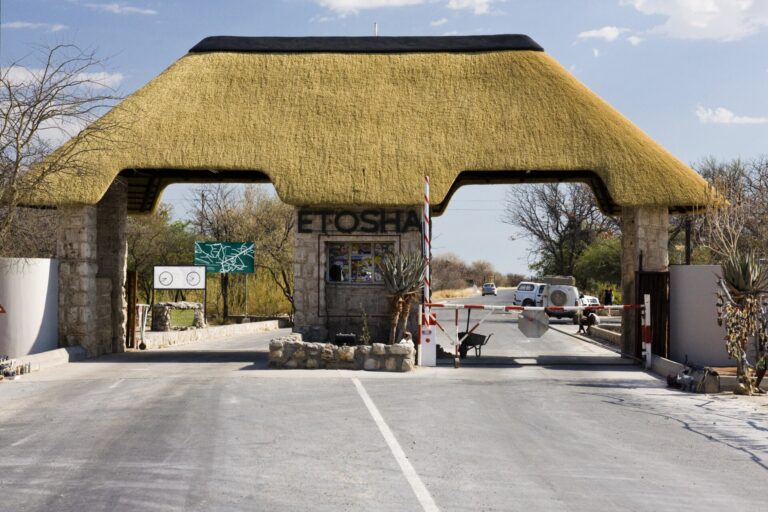
Andersson Gate history is more complex than the surname above Etosha’s southern entrance suggests. The name remembers Charles John Andersson, who travelled through northern Namibia with Francis Galton in 1851. Yet the Etosha landscape, routes and water sources were known, named and used by African communities long before either European arrived.
A responsible account therefore begins with the people and knowledge that made travel through the region possible. It also distinguishes a European written record from “discovery”, and places the gate inside the later history of colonial rule, park proclamation and dispossession.
For today’s visitor, Andersson Gate is both a practical threshold and a prompt to ask whose stories appear on a map. This guide offers nine contexts for reading the name with more care.
Andersson Gate history starts before Andersson
Etosha was known, inhabited and connected
The salt pan and surrounding country were not an unmapped blank. Hai||om people lived, hunted, gathered and moved through areas within and around today’s park. Oshiwambo-speaking communities to the north and Otjiherero-speaking communities around the wider region were part of social and trading networks.
The Xoms |Omis account of Hai||om history in Etosha describes a territory connected to neighbours and trade rather than an isolated wilderness. That context matters whenever a colonial-era explorer is credited with “finding” Etosha.
Names carry different viewpoints
Etosha is commonly linked to an Oshindonga expression for the great white place. Hai||om names and meanings also record intimate knowledge of the pan and its waterholes. A single modern park map cannot contain all those linguistic and cultural layers.
Good Andersson Gate history does not erase the familiar name. It explains that the name is one layer placed over a much older human landscape.
Written archives are incomplete
European journals can provide dates, routes and descriptions, but they reflect the author’s priorities and language. Oral history, place names, archaeology and community memory answer different questions. Reading several kinds of evidence produces a fuller account than treating one travel narrative as the whole story.
That wider evidence is the foundation of responsible Andersson Gate history.
Who was Charles John Andersson?
A Swedish-born traveller and naturalist
Charles John, or Karl Johan, Andersson was born in Sweden in 1827. He became known as a traveller, trader, hunter and naturalist in southern Africa. His interests included birds and other natural history, but his life also belonged to the commercial and imperial networks of the nineteenth century.
A historical figure, not a simple hero
Older accounts often celebrate explorers without asking who guided them, supplied them or already knew the terrain. Modern readers can value Andersson’s records while questioning the assumptions within them. That is not an attempt to delete history; it is a way to read the record more accurately.
The National Archives of South Africa catalogue of Andersson papers shows the extent of correspondence and travel material available to researchers. An archive is evidence, but interpretation still requires context.
Why a gate bears his name
The southern entrance near the Okaukuejo sector was named for Andersson, while the western entrance carries Galton’s name. Together they place two European travellers prominently on the contemporary visitor map. The names reflect a particular tradition of commemoration rather than the full history of either place.
The 1851 journey in Andersson Gate history
Andersson travelled with Francis Galton
Andersson and the English traveller Francis Galton journeyed in the region together. Historical accounts place their recorded encounter with the Etosha Pan in May 1851. They were travelling in connection with African traders and routes; they did not move through an unknown, peopleless space.
“First European record” is the careful phrase
They are often described as the first Europeans to record the pan. That statement concerns a surviving European documentary tradition. It does not mean they were the first people to see, name or understand Etosha.
This distinction is central to Andersson Gate history. “Recorded by European travellers” describes the evidence. “Discovered” incorrectly removes the knowledge of people already living and trading in the region.
Their accounts shaped an outside audience
Published travel narratives carried descriptions of northern Namibia to readers in Europe. Such books influenced later ideas about exploration, wildlife and territory. They also filtered places and people through nineteenth-century expectations.
The date is not the whole turning point
A visitor may remember 1851 because it attaches neatly to two names. The larger changes came through later colonial administration, veterinary policy, hunting regulation, land control and conservation. The gate story is therefore a doorway into a much longer timeline.
Seen on that timeline, Andersson Gate history connects travel writing with later decisions about land and access.
From lived landscape to colonial conservation area
Etosha was proclaimed a reserve in 1907
German colonial authorities proclaimed a very large protected area in 1907. Its borders, name and legal status changed repeatedly afterward. The present park is the result of those political decisions, not a timeless shape drawn by nature.
The Ministry’s State of Protected Areas report places Etosha’s proclamation and changing geography within Namibia’s protected-area system.
Conservation imposed human costs
Colonial conservation restricted access and ultimately displaced Hai||om residents from the park. The history cannot be told only as the protection of animals. It also includes exclusion, loss of land and continuing debates about recognition and rights.
Boundaries moved
The reserve proclaimed in 1907 was far larger than the modern park. Later reductions and redefinitions altered relationships between wildlife, farming areas and communities. A contemporary gate makes the boundary feel fixed, but that line has a political history.
For deeper research, Ute Dieckmann’s Hai||om in the Etosha Region centres settlement, ethnicity, conservation and dispossession rather than treating the park as empty wilderness.
Conservation history has several voices
Park staff, scientists, neighbouring communities, tourism workers and displaced families can describe the same period differently. Andersson Gate history is best understood as a set of connected perspectives, not a celebratory plaque with one meaning.
Nine contexts behind the Andersson Gate name
- Etosha’s people and place names predate every European travel account.
- Andersson was a Swedish-born traveller, trader, hunter and naturalist.
- He travelled with Francis Galton through northern Namibia in 1851.
- African knowledge, guides and trade routes made such journeys possible.
- The pair produced an early European written record of the pan, not its human discovery.
- Published narratives shaped how outside audiences imagined the region.
- The colonial reserve proclaimed in 1907 transformed access and authority.
- Hai||om dispossession is inseparable from the park’s conservation history.
- The modern gate name represents one commemorative layer, not the whole landscape.
Keeping these contexts together prevents Andersson Gate history from collapsing into either hero worship or a single corrective sentence. The purpose is a clearer, more honest account.
What Andersson Gate does today
It is a working park entrance
Many visitors use the gate for the southern approach to the Okaukuejo sector. Entry formalities, permits, operating procedures and opening times are practical matters that can change. Check current information with the park or accommodation rather than relying on an old blog timetable.
The threshold changes traveller behaviour
Before the gate, the road is part of a public transport network. Inside, park rules, speed limits, wildlife priority and restrictions on leaving the vehicle apply. Finish calls and loose-item organisation before moving into game-viewing mode.
It connects history to the first drive
Pause without blocking traffic and look at the structure, name and surrounding vegetation. The gate can frame questions to carry into the park: who named a waterhole, who worked there, how did the boundary change and what stories are absent from the sign?
How to visit Andersson Gate thoughtfully
| Before arrival | At the gate | After entering |
|---|---|---|
| Confirm current times, documents and booking details | Follow staff directions and keep traffic lanes clear | Obey park rules and allow wildlife to set the pace |
| Read more than one history of Etosha | Treat names as prompts, not complete explanations | Notice Indigenous names and the geography they describe |
| Plan fuel, food and overnight logistics | Be patient with administrative checks | Support respectful guiding and interpretation |
Use precise language
Say that Andersson and Galton were among the first Europeans to record the pan, not that they discovered Etosha. Precision acknowledges both the documentary event and the people whose knowledge preceded it.
Precise wording is a small but important part of sharing Andersson Gate history with future visitors.
Ask guides where their information comes from
A thoughtful guide can connect wildlife sightings with place names, land use and community history. If a claim is uncertain, treat it as a question for further reading instead of a polished fact.
Do not turn the entrance into a photo obstruction
Take photographs only where permitted and never stop in a lane. Staff instructions and vehicle movement come first. A responsible photograph preserves the structure without delaying other visitors.
Place Andersson Gate on a longer Etosha timeline
| Period | Event to understand | Why it changes the gate story |
|---|---|---|
| Before European travel writing | Indigenous communities knew, named and used the wider Etosha landscape | The history begins with lived knowledge, not a European arrival. |
| 1851 | Andersson and Galton reached and described the pan in European accounts | Their writing influenced later outside awareness but did not constitute discovery. |
| Late nineteenth century | Trade, hunting and colonial expansion reshaped movement and power across the region | A traveller narrative sits within wider economic and political change. |
| 1907 | The German colonial administration proclaimed a very large game reserve | Protection was created through colonial authority and affected existing land use. |
| Twentieth century | Boundaries, access and conservation priorities changed repeatedly | The modern park is not identical to the first reserve on a map. |
| Independent Namibia | Etosha operates within a national conservation and tourism system | Current management, neighbouring communities and tourism shape the meaning of the entrance today. |
Distinguish a written record from lived history
European journals are important sources because they provide dates, descriptions and the perspective of particular travellers. They are not neutral windows onto an empty landscape. Read who produced the account, for which audience and with what limits. Then place it beside oral history, archaeology, Indigenous place names and later scholarship.
This approach does not erase Andersson from Andersson Gate history. It explains why his name is present while refusing to let the name become the entire past.
Read exploration language carefully
Words such as discovery and untouched can hide people who already knew routes, water and seasonal conditions. Prefer precise statements: the travellers recorded the pan for a European readership, or their account became influential in European geographical knowledge. Precision preserves the documentary fact without repeating a colonial myth.
The same care applies to maps. A line or label shows the priorities of its maker and date. Compare maps across periods before treating one boundary as permanent or natural.
Understand why a gate name matters
Most visitors encounter the name while concentrating on permits, luggage and the first wildlife drive. That brief moment still shapes memory. A guide who adds two accurate sentences about Indigenous knowledge and the 1851 travel record turns a functional entrance into a place of interpretation.
Names also provide a useful prompt to ask which people are absent from signs. Responsible history is not a search for one replacement hero; it is a practice of recognising many kinds of knowledge, labour and consequence.
Connect proclamation with boundary change
The reserve proclaimed in 1907 was much larger than the present park, and later reductions changed ecological connections and human access. Avoid describing proclamation as the simple beginning of conservation. It created legal protection for wildlife while operating through a colonial system and producing effects that must be examined critically.
The current park’s value is real, but its history includes both protection and exclusion. Reading these together gives visitors a stronger understanding of why modern conservation increasingly considers landscapes beyond a fence.
Use the entrance as the start of inquiry
Before travel, save one reliable historical source and one current park source. During the visit, note place names and ask guides how they learned the story. Afterwards, check claims that sounded too neat. Do not repeat a dramatic anecdote online without verifying it, particularly when it diminishes local people or presents uncertain events as fact.
A thoughtful visitor can appreciate the gate, enter efficiently and still recognise that Andersson Gate history extends far beyond the man commemorated by the sign.
Build a short reading list with different viewpoints
Choose an early travel account, a modern historical or conservation study, and a source that centres Namibian or community perspectives. Note the publication date and purpose of each. When the sources disagree, identify whether they use different evidence or simply repeat an earlier claim.
Museum displays, guide narratives and websites can all be useful starting points, but check citations before quoting them as fact. A responsible visitor distinguishes a documented event, an oral tradition and an interpretation instead of flattening all three into one story.
Share the resulting account in proportion to the evidence. The goal is not a longer legend about a gate; it is a more accurate explanation of people, place and changing conservation.
Connect history to present-day visitor choices
Choose guides and interpretation that acknowledge local knowledge, current conservation work and neighbouring communities. Treat cultural information with the same demand for accuracy applied to wildlife facts. If a tour or souvenir repeats a discovery myth, ask for the source instead of accepting it because the story is familiar.
Visitors cannot resolve the past at an entrance gate, but they can avoid repeating its simplest distortions. Careful language, respectful questions and support for well-researched interpretation make Andersson Gate history relevant to the journey now.
Photograph the gate sign only where stopping is permitted, then record the questions it raised. A caption can identify the 1851 European account while acknowledging earlier Indigenous knowledge and the later 1907 proclamation. That brief, accurate wording is more useful than a claim that one traveller found an unknown place. Link readers to sources so the history remains open to further learning.
Common Andersson Gate history questions
Did Charles John Andersson discover Etosha?
No. Etosha was already known, named and used by local communities. Andersson and Galton are associated with an early European written record from 1851.
Was the present park created in 1851?
No. The travel record and park proclamation are different events. The colonial reserve was proclaimed in 1907, and its boundaries later changed substantially.
Why keep discussing the gate name?
Names influence what visitors remember. Explaining the name alongside Indigenous history and colonial conservation makes the visit richer and more accurate.
Can I enter at Andersson Gate and leave elsewhere?
A cross-park itinerary may be possible when routes, bookings, gate access and time allow. Check current conditions and build a conservative schedule rather than assuming every gate suits every trip.