
The first rains in Etosha do not transform the entire park overnight. One storm may darken the soil, fill shallow depressions and trigger a flush of green while another sector remains dusty.
For travellers, the biggest change is unpredictability. Wildlife may disperse from permanent waterholes, roads may become rough or temporarily restricted, and afternoon light can shift from harsh sun to dramatic cloud in minutes.
A green-season visit rewards flexibility. Pack for heat and rain, ask about current road conditions each day and replace a rigid species checklist with attention to feeding, birds, young animals and the changing sky.
In this guide
- How quickly the landscape changes
- Why waterhole patterns shift
- Birds and insects after rain
- Storm and road planning
- Photography in fast weather
- Eight changes to expect
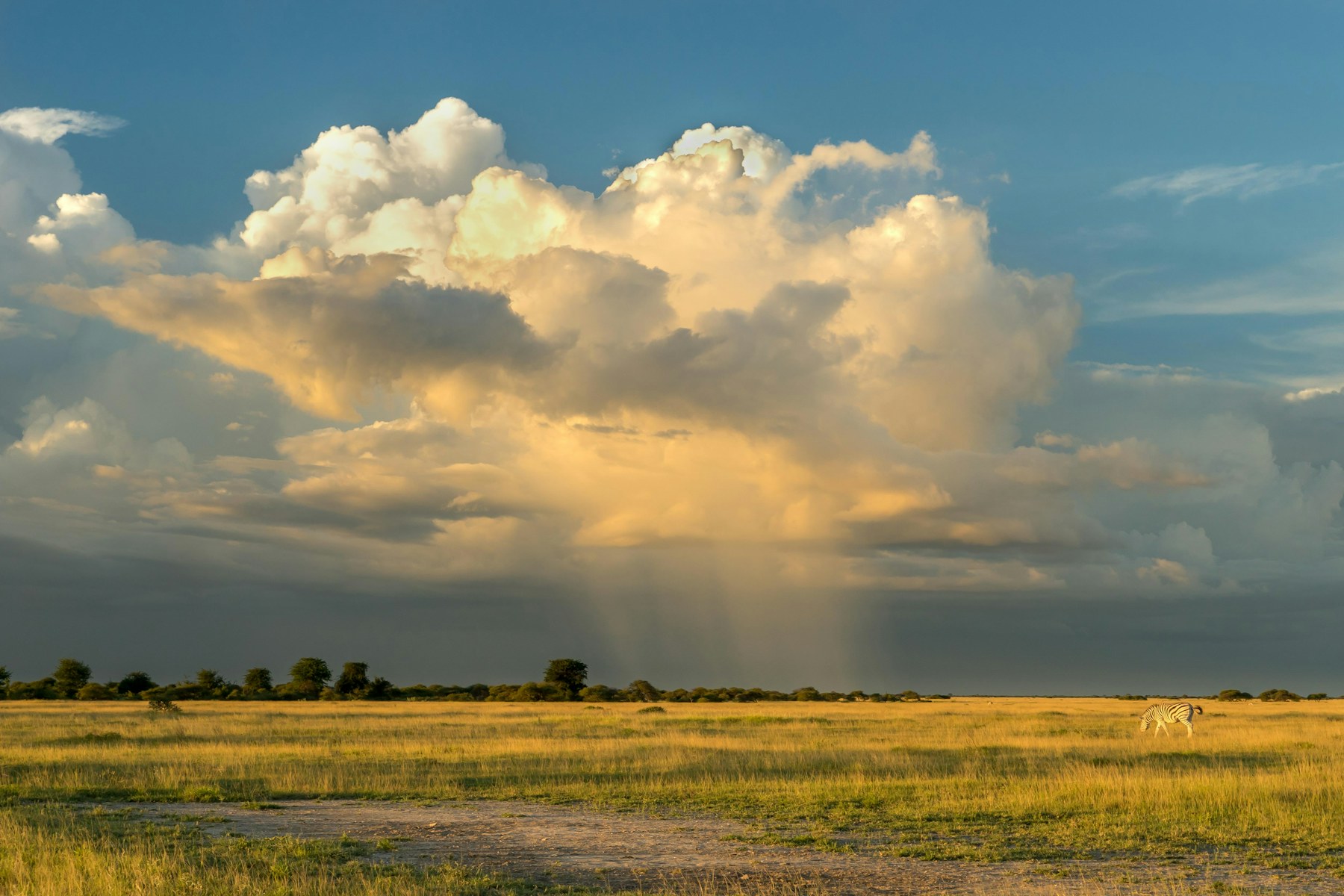
What the first rains in Etosha look like
Early showers are often local. Fresh grass can appear in patches, leaves open on selected shrubs and damp soil hold tracks clearly. A few millimetres of rain may change colour without creating deep standing water.
Repeated rain is needed for a more widespread seasonal transformation. Do not promise a uniformly green park on a particular date; annual timing and totals vary, and short dry spells can follow the first storm.
Wildlife moves away from predictable waterholes
When temporary water and fresh grazing become available, herbivores can spread across the landscape. Famous dry-season waterholes may be quiet while plains, drainage lines and roadside grass carry more activity.
Predators respond to prey rather than to a traveller’s map pins. Scan shade, the downwind edge of herds and open ground around feeding animals. The site’s Etosha Pan wildlife-movement guide explains why viewing strategies should change with conditions.
| Dry-period habit | After early rain | Better traveller response |
|---|---|---|
| Long waterhole wait | Animals may drink elsewhere | Drive slowly through fresh grazing. |
| Dust-focused tracking | Tracks show in damp soil | Look at legal road margins. |
| Clear midday sky | Storm build-up possible | Keep a short return option. |
| Predictable open views | Vegetation begins to grow | Watch movement and ears. |
Birds, insects and small life become more visible
Insects can emerge rapidly, attracting swallows, rollers and other insect-eating birds. Frogs may call around temporary water, and flowering or seeding plants create new feeding opportunities.
This activity is easy to miss when the group looks only for large mammals. Carry binoculars and pause safely when birds hawk low over the road. Keep vehicle windows managed at camp if insects are drawn to lights, and use repellents according to their instructions.
Storms change the driving plan
Dark clouds do not always mean rain at the vehicle, but lightning, wind and sudden downpours require attention. Keep enough time to return without rushing and never shelter beneath an isolated tree on foot.
Wet roads can become slippery or rutted. Obey closures, avoid widening tracks around puddles and ask camp staff for the latest information. The official Ministry of Environment, Forestry and Tourism is the national authority; on-the-day park instructions take precedence.
Rain is not a reason to test the vehicle
Four-wheel drive does not make a closed or saturated road acceptable. Turn around early and keep the recovery number from the rental company available.
Use a well-placed base when weather changes
A stay near the sector you want to explore gives you shorter loops and an easier return when a storm closes the afternoon. Compare camps and lodges by route, not only room style.
Pack for heat, water and insects
Carry a breathable rain layer where it can be reached without unpacking. Use closed shoes around camp after dark, protect cameras with a simple cover and keep a dry bag for documents and chargers.
Continue sun protection even under broken cloud. Heat and humidity can remain high, and dehydration is easy to overlook in cooler wind. Refill drinking water before each circuit.
Photography after the first storms
Use storm light to show colour, cloud and reflections rather than waiting only for an animal portrait. Protect equipment before rain reaches the vehicle, not after the first drops. A clean windscreen and lens cloth matter when shooting through an open side is unsafe.
Expose for bright cloud highlights and let the foreground remain slightly dark if necessary. Avoid exaggerating saturation until grass and sky look unreal. The contrast between dry and wet patches is part of the honest story.
Eight fascinating changes for travellers
Watch for a combination rather than expecting all eight on the first wet day.
- Darker soil and clearer tracks
- Fresh grass in local patches
- Temporary surface water
- More dispersed grazers
- Increased insect activity
- Changing bird behaviour
- Variable road access
- Dramatic cloud and softer light
A ten-point field study of first rains in Etosha
The following study prompts help travellers document first rains in Etosha without treating one visit as a universal pattern. They are designed for normal legal viewpoints and roads; they never authorise entry onto a closed track, pan surface or sensitive habitat.
1. What the first rains in Etosha look like
Use “What the first rains in Etosha look like” to separate weather from season. One shower, cool morning or patch of green does not describe the whole landscape. Record date, broad sector and recent local information so first rains in Etosha is interpreted as a changing process rather than a fixed calendar event.
2. Wildlife moves away from predictable waterholes
Trace the water behind “Wildlife moves away from predictable waterholes”: direct rain, temporary pooling, catchment inflow, a permanent source or an artificial point can produce different wildlife responses. first rains in Etosha becomes clearer when travellers ask where water came from, how long it may persist and which habitats remain dry.
3. Birds, insects and small life become more visible
Compare “Birds, insects and small life become more visible” at two locations instead of generalising from one viewpoint. Wind, soil, shade and rainfall vary across Etosha. A quiet western waterhole and active eastern grassland can both be normal during first rains in Etosha; the difference is information, not a contradiction to be explained away.
4. Storms change the driving plan
Look below the largest mammals when studying “Storms change the driving plan”. Insects, fresh tracks, seedlings, frogs and small birds often respond before a dramatic landscape change is obvious. These details give first rains in Etosha a time sequence and prevent the visit becoming only a search for a headline species.
5. Pack for heat, water and insects
Ask how herbivores alter movement around “Pack for heat, water and insects”. New grazing can disperse animals; limited water can concentrate them; mud or tall grass can shift approach routes. first rains in Etosha should change the scanning plan, not create a guarantee that animals will be easier or harder everywhere.
6. Photography after the first storms
Use “Photography after the first storms” to review predator assumptions. Predators respond to prey, shade, cover and disturbance rather than a tourist timetable. During first rains in Etosha, scan herd edges, downwind cover and movement corridors, but report only what is seen and avoid converting habitat theory into a promised sighting.
7. Eight fascinating changes for travellers
Check road consequences before following “Eight fascinating changes for travellers”. Wet margins, ruts, dust, standing water or a closure are management and safety signals. No vehicle class authorises a bypass. The responsible first rains in Etosha route accepts a shorter drive when the surface or official instruction requires it.
8. Etosha rainy season
Photograph “Etosha rainy season” with a fixed reference such as the road edge, horizon, tree or animal group. Repeat the frame later when practical. This documents first rains in Etosha without exaggerating scale, colour or water depth, and it makes the comparison more useful than an isolated dramatic edit.
9. first summer storms
Discuss uncertainty around “first summer storms” in the caption or field note. Use “may,” “at this location” and “during our visit” when evidence is limited. Responsible writing about first rains in Etosha distinguishes current observation from long-term pattern and links readers to an authoritative source for broader context.
10. green season wildlife
Finish the “green season wildlife” review by asking what changed the next day. Evaporation, another storm, wind, grazing or road management may alter the same sector quickly. first rains in Etosha is best understood through repeated, humble observation rather than one viral image treated as a normal annual scene.
11. wet-season driving
Connect “wet-season driving” to scale. Estimate whether the observation covers a puddle, one waterhole, a pan margin or a broad sector, and state that scale explicitly. first rains in Etosha reporting becomes misleading when a close photograph of one patch is described as if the entire national park shared the condition.
12. How quickly the landscape changes
Use “How quickly the landscape changes” to compare animal needs. Grazers, browsers, water-dependent species, raptors and scavengers do not respond identically. A useful first rains in Etosha note names the observed species and behaviour without treating one group as a proxy for every animal in Etosha.
13. Why waterhole patterns shift
Check the time lag behind “Why waterhole patterns shift”. Vegetation, insects and animal movement may respond hours or weeks after rainfall or drying. first rains in Etosha should therefore connect current appearance with recent history where reliable information exists, while avoiding precise causal claims from one drive.
14. Birds and insects after rain
Observe how “Birds and insects after rain” changes sound and visibility. Wet ground, wind, foliage and insects can alter what travellers hear and how far they see. Incorporating those sensory conditions makes first rains in Etosha interpretation more complete and helps explain why the same route produces different detections.
15. Storm and road planning
Review “Storm and road planning” with an authoritative source after the drive. Use the source for long-term ecology or history and the field note for that day’s local condition. Responsible first rains in Etosha writing keeps those evidence levels separate and corrects the article if official guidance changes.
16. Photography in fast weather
End “Photography in fast weather” by identifying one question that remains open. It might concern water origin, bird movement, boundary history or vegetation response. Good first rains in Etosha turns uncertainty into a research question rather than filling the gap with a confident but unsupported explanation.
Compare the ten prompts after two different drives. The differences reveal how local and temporary first rains in Etosha can be. Share the observation with dates and broad location, and avoid language that promises the same condition to someone travelling months later. Keep photographs in sequence with basic weather notes, then revisit them after the trip with an authoritative ecological or historical source. The comparison should refine the interpretation without erasing uncertainty.
Adapt daily to the first rains in Etosha
The first rains in Etosha reward a fresh route check each morning. After the first rains in Etosha, grazing and water may disperse animals that were predictable in the dry season. Use the first rains in Etosha to watch seasonal behaviour rather than chase an old sighting list.
First rains in Etosha: common questions
The answers are deliberately flexible because early-season rainfall varies sharply.
When do the first rains usually arrive?
They are associated with the warmer rainy-season build-up, but the first effective rain varies by year and location. Check recent local conditions instead of planning around one exact date.
Does one storm fill the Etosha Pan?
Not necessarily. Local showers may create patches of water or damp ground; broader pan flooding depends on rainfall and catchment inflow over time.
Will wildlife be harder to see?
Waterhole concentration can decrease as animals disperse, but fresh grazing and seasonal behaviour create different viewing opportunities.
Are roads closed after rain?
Some routes may be closed or restricted according to conditions. Follow signs and staff instructions and never bypass a barrier.
Do travellers need a 4×4?
Suitability depends on the approved route, conditions and rental contract. No vehicle type authorises entry onto a closed road.
Is the rainy season good for photography?
Yes, for cloud, colour, reflections and behaviour. Protect equipment and accept that some drives will be shortened by weather.
Let the weather rewrite the route
Ask what changed overnight, choose shorter loops and watch the small responses to rain. Flexibility is the green season’s most useful piece of equipment.