
Black-backed jackals in Etosha are easy to dismiss when larger predators are nearby, yet they offer some of the park’s most accessible behaviour. A patient observer may see a territorial patrol, a mated pair coordinating, an individual hunting insects or several jackals negotiating access to a carcass.
Their adaptability does not make them tame. Keep food secured, never call or feed them and describe only the behaviour actually seen.
In this guide
Identify black-backed jackals in Etosha
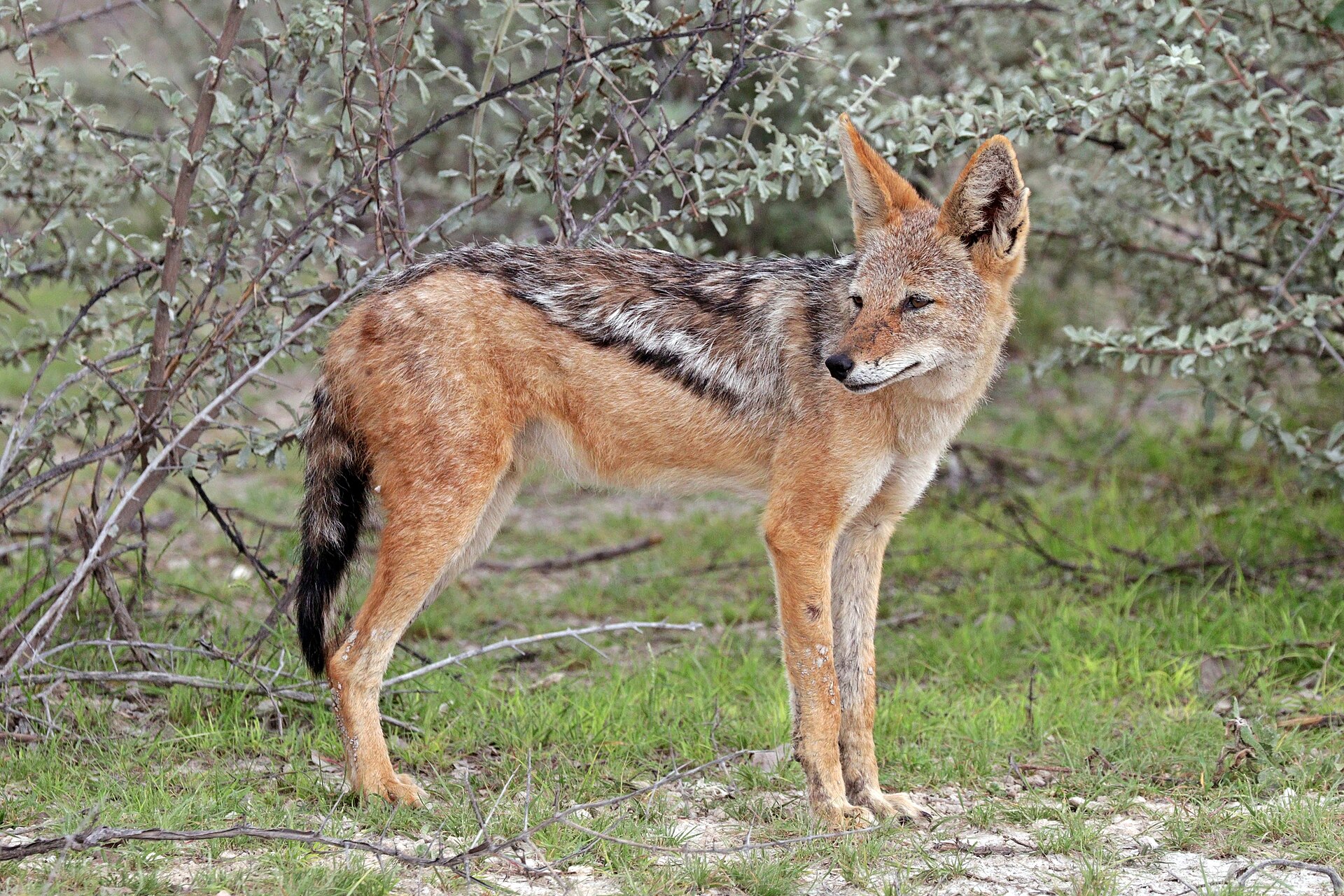
The dark saddle across the back contrasts with rusty flanks, a pale underside and pointed ears. Size can be misleading at distance, so combine coat pattern, tail position and movement rather than relying on a single impression.
Jackals often travel with an economical trot and pause to listen. A lone animal may be hunting, patrolling or moving between family members; solitude does not prove that it lacks a mate or territory.
Watch pair bonds and territorial behaviour
peer-reviewed research on black-backed jackal social organisation documents the importance of social structure and space use. Visitors may notice scent marking, close parallel movement, greeting or long-distance calls, but one brief encounter cannot establish the full family group.
- Record which animal initiated the interaction.
- Note whether tails and ears changed.
- Listen for calls without imitating them.
- Avoid blocking the direction in which a pair is travelling.
They hunt as well as scavenge
Black-backed jackals take insects, rodents, reptiles, birds and other small prey, and they also use carrion. Near a carcass they may test distance repeatedly, withdraw from a hyena or lion and return when the risk changes.
recent open-access dietary research is a useful reminder that diet changes with opportunity. A photograph at one carcass should not be turned into a claim that jackals eat only carrion.
Use a quiet roadside method
Stop where legal without surrounding the animal. Switch off the engine when conditions and traffic allow, keep voices low and give the jackal a clear path away from the road. Sudden door movement can interrupt hunting.
| Observation | Possible context | What not to assume |
|---|---|---|
| Ears fixed on grass | Listening for small prey | That a kill is certain |
| Repeated scent marking | Territorial or social information | The exact boundary |
| Waiting near larger predators | Assessing feeding opportunity | That the jackal is harmless to approach |
| Paired travel | Bonded or familiar animals | That pups are nearby |
Keep camp and waterhole behaviour responsible
Never reward a jackal for approaching people. Human food changes behaviour and can create conflict that outlasts a single visitor. Store rubbish, cool boxes and cooking ingredients securely and follow every camp rule.
For a wider predator context, use the Etosha wildlife guide and compare patient observation with the guided game-drive guide.
Write better jackal field notes
Record time, number of animals, travel direction, calls and the exact interaction before adding an interpretation. “One jackal paused and looked toward vultures” is stronger than “a scavenger waited for food.” This method protects the animal from old stereotypes and makes photographs easier to caption accurately. Compare the observation with the Etosha wildlife guide, but keep an unusual event unusual rather than turning it into a rule for the species.
black-backed jackals in Etosha: practical questions
Are black-backed jackals only scavengers?
No. They hunt small prey and also use carrion when it is available.
Do jackals live alone?
They may be seen alone, but pair bonds and family-based social organisation are important.
Is it safe to feed a jackal at camp?
No. Feeding wildlife is irresponsible and can create dangerous habituation.
Black-backed jackals in Etosha reward observers who look past size. Watch the sequence, leave room for natural choices and treat every call or quick hunt as part of a much larger social life.
black-backed jackals in Etosha summary: Check current local conditions, protect realistic travel time and keep wildlife behaviour natural.